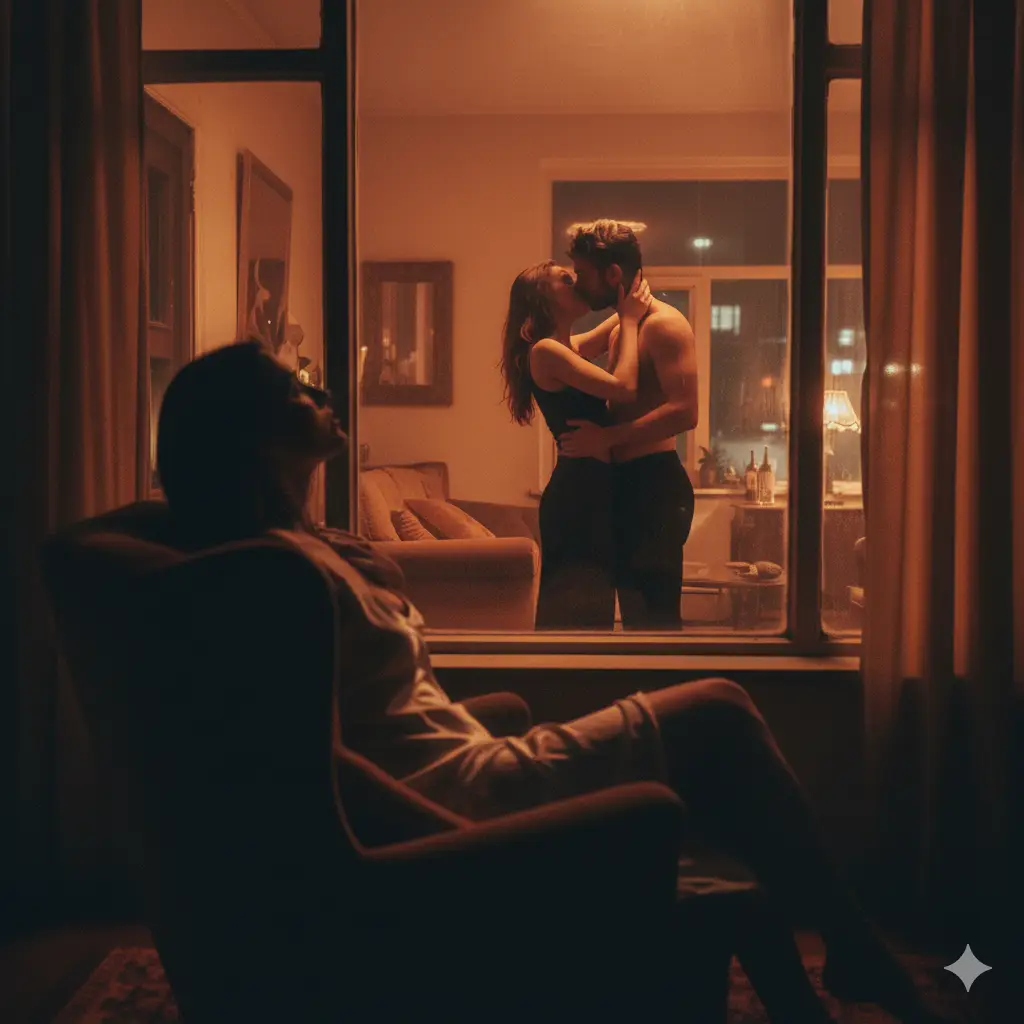
There is a quiet intensity in watching, truly watching that borders on the sacred. Not the hurried glance, not the invasive stare, but the slow, deliberate absorption of a moment not meant for you. In that suspended breath between observation and participation, something profound unfolds: a convergence of desire, imagination, and restraint.
Voyeuristic pleasure, often misunderstood or moralized into shame, is in truth one of humanity’s most refined erotic capacities. Unlike other species whose occasional onlooker behavior during mating serves mimicry or learning, humans alone transform observation into full-bodied arousal. We do not watch to copy. We watch to feel. To dream. To ignite inner theaters where fantasy and reality blur into something richer than either alone.
Consider how we admire art: a Rothko canvas, a Caravaggio chiaroscuro, an art piece of Kent Monkman, a dancer mid-leap in a silent rehearsal room. We derive deep aesthetic, even emotional, satisfaction without touching, without owning, without interrupting but feeling and embracing an ocean of emotions. This serves the fundamental principles for erotic voyeurism. The eyes become portals, not just to another’s body, but to the unspoken poetry of intimacy: the arch of a back, the tremor in a sigh, the private rhythm of two bodies speaking a language older than words.
This is not objectification. Not when done with reverence. It is witnessing. And witnessing, when rooted in awe rather than entitlement, is a form of love.
The pleasure lies not in possession, but in distance. In the exquisite tension of almost. It is the mind that finishes what the eyes begin, and the human mind, with its capacity for narrative, memory, and metaphor, turns a glance into a symphony.
This is why voyeurism, at its highest expression, resembles art appreciation. Just as one stands before a sculpture and feels the marble’s coolness in the soul, so too can one watch an intimate act and feel arousal not as crude instinct, but as aesthetic resonance. The body responds because the spirit has been moved.
And let us not forget: the eyes are humanity’s primary sensory gateway. Among millions of species, we are the only ones who weep at sunsets, who pause before ruins, who frame moments in photographs not to capture, but to contemplate, to feel and to remember. Is it any wonder, then, that we extend this contemplative gaze to the most primal of human acts?
Erotic voyeurism, when consensual, whether through performance, shared fantasy, or mutual awareness, is not degradation. It is an elevation. It transforms sex from mere mechanics into theater, into ritual, into living sculpture.
In tantra, we learn that pleasure need not culminate in climax to be complete. Sometimes, the longest, most exquisite note is the one held just before release. Voyeurism lives in that note. It is the pleasure of anticipation, of imagination unfettered, of desire distilled into pure perception.
So let us reclaim this gaze from shame. Let us honor it as a testament to human complexity, that we can be aroused not just by touch, but by the poetry of another’s unguarded moment. That we can find ecstasy in stillness. That we can love with our eyes wide open.
For in the end, to watch with reverence is to acknowledge the beauty of being human, together, yet solitary; exposed, yet mysterious; carnal, yet transcendent.
And that is not perversion.
That is art.

Dhanuka Dickwella is a distinguished Sri Lankan poet, author, and multifaceted professional whose work spans literature, geopolitics, and social activism. Holding a Master’s degree in International Relations, he has established himself as an expert in geopolitics and geoeconomics, fields that inform his analytical and creative endeavours.
His professional portfolio includes significant editorial and journalistic roles: he serves as the Executive Editor of The Asian Reviews magazine, a platform dedicated to bridging the literary worlds of East and West. Additionally, he contributes as a guest writer for the Chicago-based Armenian Mirror-Spectator, focusing on geopolitical issues in the Caucasus region, and as a columnist and guest speaker for Force, an Indian magazine addressing security and defense matters. Dickwella’s career in public service is equally notable. Dhanuka Dickwella is the Chief Coordinator for Canada for the Panorama International Literature Festival 2026. He has been actively involved in Sri Lankan politics, having served as a grassroots politician, political campaign director, and council member of a local government body in a rural Sri Lankan town. Prior to his political engagements, he founded and led a foundation dedicated to empowering youth and supporting underprivileged communities, reflecting his commitment to social equity. Currently, he advises youth groups on political activism and broader political trends, leveraging his extensive experience to foster the next generation of civic leaders. Beyond his analytical and political pursuits, Dickwella is a celebrated poet and blogger whose literary work explores the complexities of human emotion and experience. His debut poetry collection, Voices of Lust, Love and Other Things, showcases his ability to weave personal narrative with universal themes. An ardent climate and social activist, he champions sustainable development and social justice, driven by a vision of a better world for future generations. A proud Sri Lankan patriot, Dickwella is also a devoted father to his daughter, whose influence is a cornerstone of his personal and creative life. Dhanuka Dickwella’s diverse achievements reflect a rare synthesis of intellectual rigor, artistic expression, and civic dedication, positioning him as a prominent voice in both Sri Lankan and global contexts.
Leave a Reply