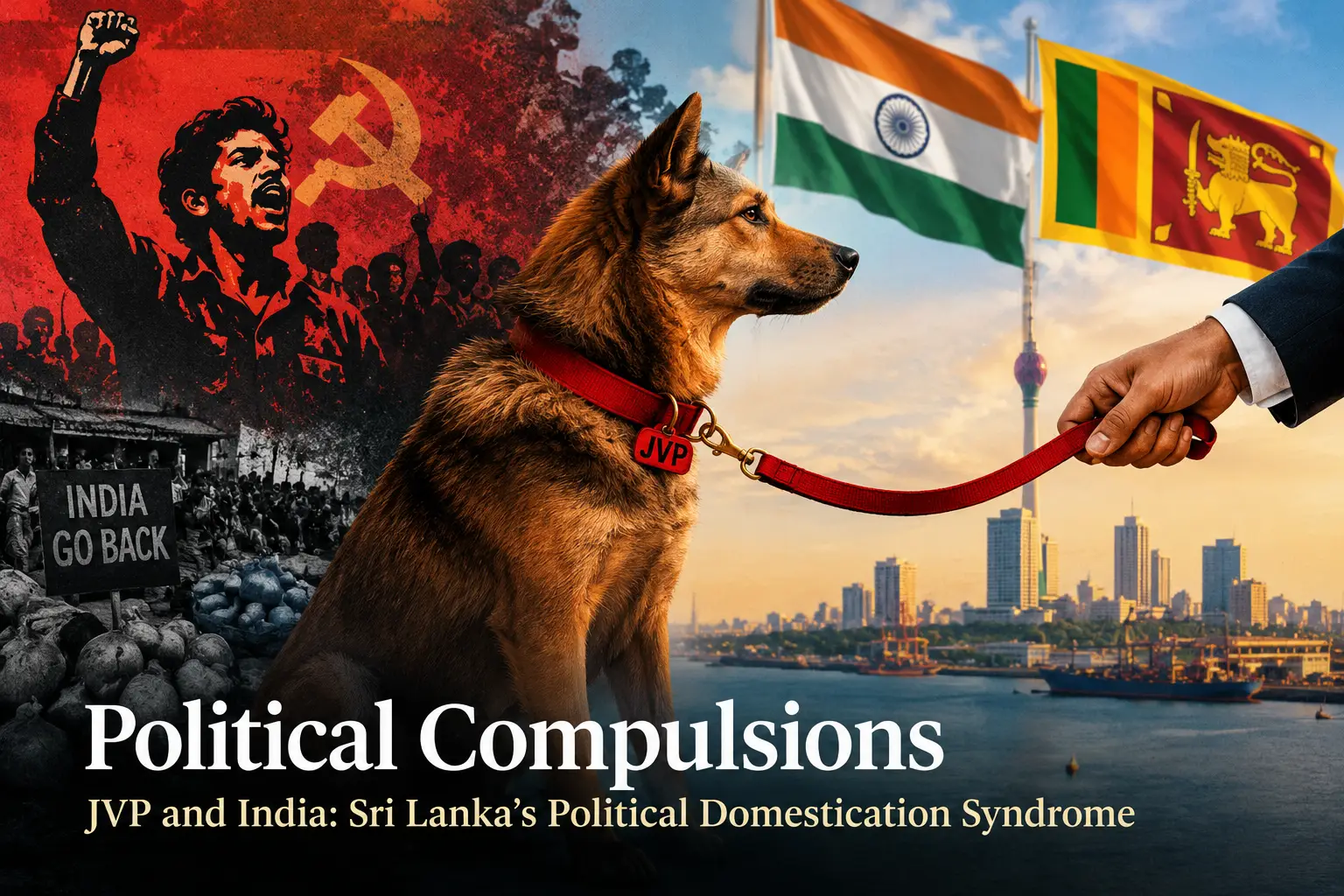
A Case Study of Political Domestication Syndrome
Every small state that lives in geographical proximity to a much larger, more powerful state undergoes an ever-evolving relationship. At times, it could be tense, at times non-existent, and in rare cases, a peaceful coexistence. This dynamic stems from a universal trend of larger powers assuming the foreign policies of smaller neighbors as potential security threats. Consequently, in unfortunate developments, such tensions could finally end up in a military flare-up. The world is full of examples of this sort, from east to west.
Whether its CIA orchestrated Bay of Pigs or the kidnapping of a sitting president, Russian tanks rolling into Georgia and Ukraine, or China’s absorption of Tibet, neighborhood bossing knows no bounds. South Asia was not spared from the trend either. Indian intervention in East Pakistan that resulted in the creation of Bangladesh to Indian intervention in Sri Lanka which created a bloody civil war that lasted 30 years, followed by Indian forces landing in Colombo, are not so distant memories of larger powers policing the smaller powers.
Driven by New Delhi’s historical unpredictability, Sri Lanka adopted a deeply cautious posture toward its northern neighbor, while its society historically viewed Indian motives with deep-seated skepticism. One Sri Lankan political movement went further, entrenching anti-Indian discourse at the very core of its identity. From boycotting Indian produced Mysore Parippu to Bombay Onions—to the violent campaign orchestrated by its military wing, the Deshapremi Janatha Vyaparaya, the anti-Indian struggle was, for this organization, beyond symbolic rhetorics.
Within the span of a couple of decades, the same comrades who once led mobs and mobilised the public against Indian interests have laid red carpets for an Indian defence head, hosting him with the highest pomp and formality. This 180-degree change could only be described by a scientific concept borrowed from evolutionary biology, known as Domestication Syndrome.
What is Domestication Syndrome?
“ Domestication syndrome is a term that describes the permanent changes that appear in plants and animals as a result of domestication. These changes make these species different from their ancestors that were living in the wilderness. Plant crops are distinguishable from their ancestors because of this syndrome, and in animals, it is the cause of the development of many changes in looks and behaviour.”
(https://www.worldatlas.com/articles/what-is-domestication-syndrome.html)
Our beloved pets, from cats to dogs who adore us unconditionally, originated in the wilderness. They were once wild species that hunted and clashed with humans for mere survival. That was, until they changed their hostile behaviour and transformed themselves to become our most trusted allies.
The similarity between the behavioural shift of wilder species from apex predators to pets, and the ideological transformation of the JVP towards India, from a violent confrontation to strategic partnership, bears a stark resemblance. The very existence of the syndrome is self-evident; however, the fundamental question here is: how did we arrive here? One needs to examine both India’s and the JVP’s evolution to come to a sound judgement.
Ever since the fall of the Gandhi political dynasty, Indian foreign policy has transmuted, adapting to the changing geopolitical realities. Although led by a nationalist political administration, India remains to be seen as a non revanchist power in classical sense. Instead, New Delhi asserts the role of a responsible world power that somehow believes in the existence of the non-existent international order and its leading institutions, such as the almost defunct United Nations. India seems to openly embrace the idea of playing by the rules. Although New Delhi has used its soft power to influence the internal decisions of its small neighbours, it remains far from deploying an IPKF-style military intervention to force outcomes in regional capitals. One could argue that this is an inherent weakness in the era of Trump–Putin–Erdogan-type macho, transactional geopolitics. Yet, the JVP’s change of heart towards Delhi speaks otherwise.
Despite being a powerful and assertive neighbor, India’s contemporary behaviour provides a sense of reassurance and gives maneuvering space for the JVP planners. Besides, the economic realities are self-explanatory. The vast Indian market of 1.4 billion people forms Sri Lanka’s backbone of the tourism and transhipment business. Although Delhi is not the primary destination of manufactured exports, it nonetheless remains a key pillar of the Sri Lankan supply chain.
The Transformation of the Movement – JVP to NPP
India’s transformation is only half the equation. The JVP itself has undergone a profound metamorphosis from a revolutionary movement operating outside the structures of the state into the political force responsible for managing the state itself.
A revolutionary movement can afford to treat foreign policy primarily through the lens of ideology. A government cannot. Once a political movement takes responsibility for an entire country, the realities of fuel, food, foreign exchange, tourism, trade, debt, ports, investment, energy, and national security suddenly become unavoidable. Geography, which may be challenged rhetorically from an opposition platform, becomes an uncomfortable reality from the presidential palace.
The JVP also had the unique case studies available from Ukraine to Cuba regarding the perils of maintaining an openly hostile posture toward a powerful neighbor. Playing the China card to squeeze concessions from Delhi, or vice versa, has proven time and again to be more problematic than pragmatic. India’s own multi-vector foreign policy allows the JVP to steer a much broader foreign policy, entertaining and engaging with all the global powers without getting dragged into bloc politics.
The economic crisis of 2022 would have provided another important lesson. During Sri Lanka’s darkest economic period in decades, India became one of the most important external sources of emergency assistance. Fuel, food, medicines, financial support and other forms of assistance demonstrated that the relationship with India was no longer simply a question of historical memory or political ideology. For a government struggling to keep the country functioning, the practical value of a relationship with its largest regional neighbour becomes difficult to ignore.
The lesson for a movement such as the JVP may therefore not necessarily have been that India had suddenly become a friend. It may have been something much more practical: Sri Lanka could no longer afford to have India as an enemy.
There is also another important difference between the JVP of the late 1980s and its current version. The political organism itself has changed. The JVP that confronted the Indo-Lanka Accord, mobilised against the IPKF and encouraged an intensely anti-Indian political struggle was a revolutionary organisation operating in a very different domestic and international environment. Whereas the NPP, which leads a coalition of civil society organisations, is an electoral vehicle seeking to govern a modern state deeply connected to the global economy.
The transformation is therefore not simply a change of foreign policy. It is also a change like the political movement itself.
This may explain why the same political tradition that once considered India’s presence in Sri Lanka an intolerable violation of sovereignty can now see strategic engagement with New Delhi as necessary for protecting the country’s economic and geopolitical interests.
Perhaps this is where the analogy with domestication becomes even more interesting.
An animal does not become domesticated simply because it suddenly decides that humans are good. Its environment changes. The pressures surrounding its survival change. Behaviour that was once advantageous in the wilderness may become unnecessary, counterproductive or even dangerous in a domestic environment.
Political movements can experience something similar.
The behaviour that helps a revolutionary movement survive may not be the behaviour required for a government to survive.
The revolutionary JVP needed mobilisation, resistance and ideological confrontation. The NPP needs stability, international legitimacy, economic recovery, diplomatic flexibility and the ability to maintain relationships with powerful neighbours.
The question, therefore, is not whether the JVP has changed. It clearly has.
The real question is whether this transformation represents political maturity, political pragmatism or something closer to the domestication of an ideological movement by the realities of governing.
And this is where the analogy becomes uncomfortable.
The real question is not about having the best behavioural change while undergoing domestication syndrome, but how deeply this syndrome affects state sovereignty in the long run.
If a revolutionary movement changes its behaviour because it has matured into a responsible governing force, that could be interpreted as political evolution.
But if the change means that economic dependency, geopolitical pressure, or the interests of a larger neighbour gradually begin to determine the strategic choices of a smaller state, then the question becomes far more serious.
At what point does pragmatism become dependency?
At what point does diplomatic accommodation become strategic submission?
And at what point does a political movement that once fought to protect sovereignty become so comfortable within the geopolitical house of its larger neighbour that it forgets why it once resisted entering it?
That, perhaps, is the real question behind the Political Domestication Syndrome.

Dhanuka Dickwella is a distinguished Sri Lankan poet, author, and multifaceted professional whose work spans literature, geopolitics, and social activism. Holding a Master’s degree in International Relations, he has established himself as an expert in geopolitics and geoeconomics, fields that inform his analytical and creative endeavours.
His professional portfolio includes significant editorial and journalistic roles: he serves as the Executive Editor of The Asian Reviews magazine, a platform dedicated to bridging the literary worlds of East and West. Additionally, he contributes as a guest writer for the Chicago-based Armenian Mirror-Spectator, focusing on geopolitical issues in the Caucasus region, and as a columnist and guest speaker for Force, an Indian magazine addressing security and defense matters. Dickwella’s career in public service is equally notable. Dhanuka Dickwella is the Chief Coordinator for Canada for the Panorama International Literature Festival 2026. He has been actively involved in Sri Lankan politics, having served as a grassroots politician, political campaign director, and council member of a local government body in a rural Sri Lankan town. Prior to his political engagements, he founded and led a foundation dedicated to empowering youth and supporting underprivileged communities, reflecting his commitment to social equity. Currently, he advises youth groups on political activism and broader political trends, leveraging his extensive experience to foster the next generation of civic leaders. Beyond his analytical and political pursuits, Dickwella is a celebrated poet and blogger whose literary work explores the complexities of human emotion and experience. His debut poetry collection, Voices of Lust, Love and Other Things, showcases his ability to weave personal narrative with universal themes. An ardent climate and social activist, he champions sustainable development and social justice, driven by a vision of a better world for future generations. A proud Sri Lankan patriot, Dickwella is also a devoted father to his daughter, whose influence is a cornerstone of his personal and creative life. Dhanuka Dickwella’s diverse achievements reflect a rare synthesis of intellectual rigor, artistic expression, and civic dedication, positioning him as a prominent voice in both Sri Lankan and global contexts.
Leave a Reply