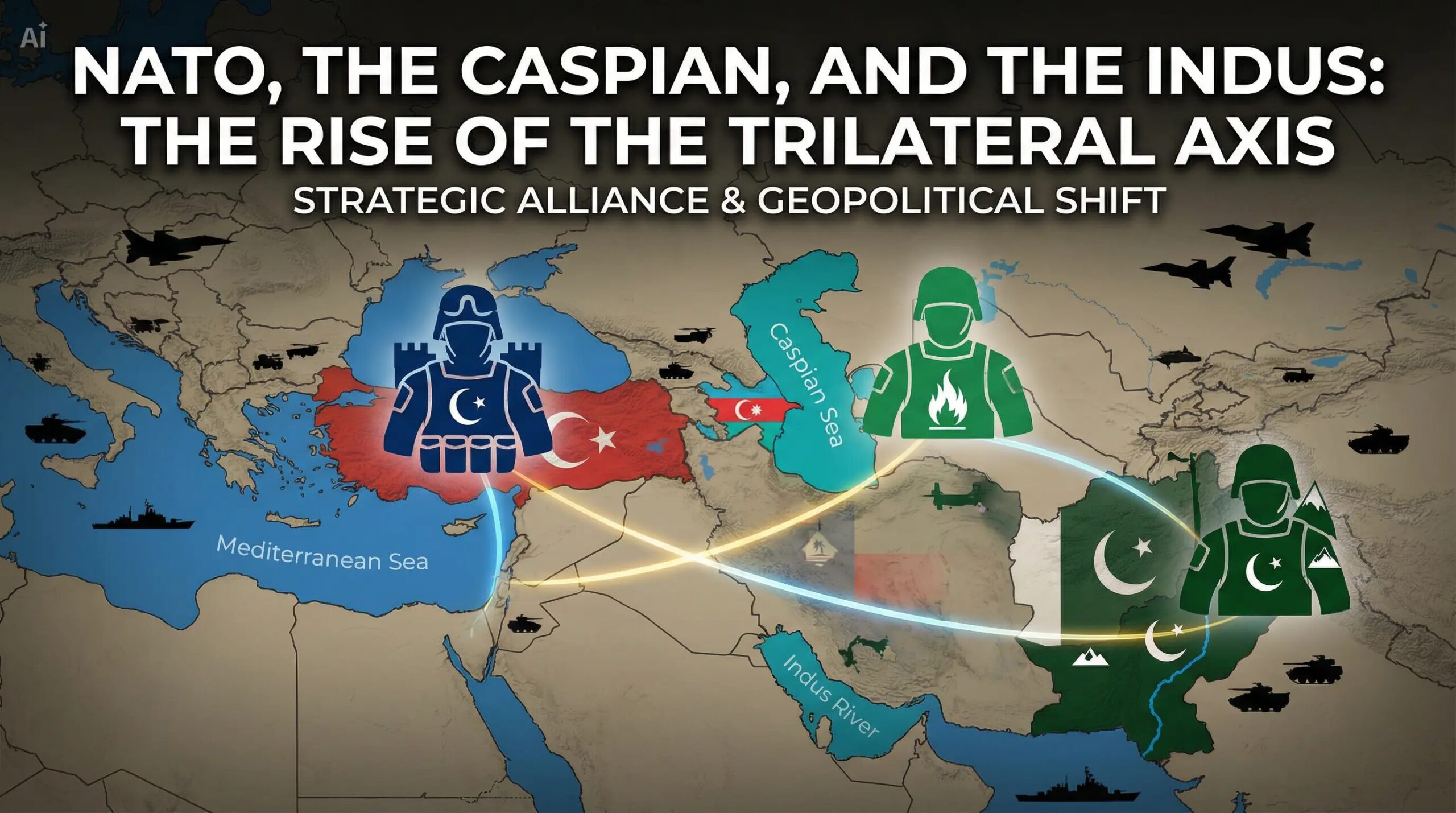
Military alliances are built on the logic of deterrence and the advancement of national interest. But the little-known ‘Three Brothers Alliance’ is built as a totally different, geostrategic axis. It is unique because it connects three nations with no shared borders into a cohesive trilateral force. By 2026, this partnership will have moved beyond symbolic military drills to become a structured, closed, strategic loop where technology, energy, and diplomatic cover are exchanged to bypass the traditional global powers. Who are the so-called three brothers?
From South Asia, India’s arch-rival, Pakistan; Armenia’s arch enemy, Azerbaijan, from the Caucasus; and finally a revisionist Turkey from West Asia. Other than being three predominantly Muslim nations of both Sunni and Shia populations, what makes them band together is an important strategic question one must raise.
The Mechanics of the Axis: Modus Operandi
Let us get the mechanics of the axis or the modus operandi between Turkish, Pakistani, and Azeri political leadership clarified first. The alliance operates through a three-front strategy, allowing each member to outsource its regional security burdens and share their unique resources.
Get the Mirror in your inbox:
In front of the subcontinent, Pakistan uses the alliance to internationally isolate India and modernize its military. On the Caucasus front, Azerbaijan leverages Turkish and Pakistani support to deter Iran and cement its control over the Zangza region by knocking Armenia out. In the front of central Asia, Turkey utilizes the coalition as a springboard for its pan-Turkish vision, challenging Russian and Chinese hegemony in the Eurasian heartland.
How does each of those players operate in other respective spheres through their brothers-in-arms? First, let’s look at Turkey, the revisionist powerhouse of Ankara.
Turkey: The Revisionist Powerhouse
For Erdogan, the three brothers coalition is a vehicle for neo-Ottoman revisionism. While Turkey remains a NATO member, President Recep Tayyip Erdogan has pivoted toward a strategic autonomy that NATO cannot provide. Challenging the Russian Caucasus underbelly by arming Azerbaijan and conducting joint drills in the Caspian Sea, Turkey checks Russian influence in the Caucasus and places direct pressure on Iran’s northern border. Most importantly, it has gained access to the Caspian seas, circumventing the rule of prohibition of non-Caspian actors’ presence. Turkey also advances with its Indian Ocean ambitions through Pakistan. Ankara gains a strategic foothold in the Indian Ocean in exchange for the Milgem class corvettes and KAN fighter jet cooperation. Turkey secures a reliable partner in a region that will define the future balance of maritime power. Ankara leverages technology as diplomacy. It has successfully turned its defense industry (Baykar, TAI) ties into a diplomatic currency, creating a path dependency where Pakistan and Azerbaijan are now technologically tethered to Ankara.
Pakistan: Breaking Isolation through ‘Deep Ties’
Now let’s look at Pakistan. At its core, Islamabad eyes breaking isolation through deep ties. Pakistan’s primary geostrategy is the neutralization of India on every front. Ever since the formation of the three brothers alliance, it has provided the strategic depth Islamabad has long sought. The best example is the Kashmir campaign. Turkey and Azerbaijan have become Pakistan’s most vocal defenders on the international stage, openly criticizing India at the UN and the Organization of Islamic Cooperation (OIC). This provides Islamabad with the diplomatic oxygen needed to keep the Kashmir issue alive despite India’s growing global stature.
AESA & Drone Modernization: facing a gap in conventional air power against India’s diverse air power, Pakistan has turned to the JF17 block 3 co-produced with China, but increasingly integrated with Turkish avionics and Turkish Akinchi drones. These tools are designed to challenge India’s cold start doctrine through high-tech attrition and asymmetric assets. Pakistan offers the alliance vast experience in unconventional warfare and special operations expertise, serving as a force multiplier for Turkish interests in Libya, Syria, and potentially the Caucasus.
Most importantly, it is the sole nuclear power with the means of delivering through medium-range ballistic missiles or the MRBMs.
Azerbaijan: The Energy and Transit Hub
Now it’s time to look at Azerbaijan, the energy and transit hub of the three. Azerbaijanis are the glue of the alliance, providing the financial and energy capital that fuels the partnership. At the beginning, Baku was seeking to back its military and political campaigns in the Karabakh wars. Now that it has achieved its primary military objectives against Armenia, Baku is undertaking to create a sphere of influence beyond the borders. Think of the frontier with Iran. In the long run, Baku aims to deter Iran and perhaps extend its border on a weakened Iran. The latest example was what transpired following the 2026 Iranian drone strikes on Nakchivan. Azerbaijan has utilized the alliance to signal that an attack on Baku is an attack on Ankara and Islamabad. This has effectively created a buffer against Iranian regional ambitions.
Weaponizing transit: Azerbaijan is a critical node in a number of Eurasian trade routes. Most notably, the Middle Corridor (Trans-Caspian International Transport Route – TITR), International North–South Transport Corridor (INSTC) and the TRACECA (Transport Corridor Europe-Caucasus-Asia). For both China-led belt and road initiative or the BRI and the India-led INSTC, Baku acts as a strategic gatekeeper. Baku’s primary aim is to elbow out Armenia in the long run from playing any significant role in any of those communication channels.
Geostrategy for India: Russia and China: The Looming Challenge
The three brothers alliance has profound geostrategic consequences for three global powers namely Russia, China, and India. Those looming challenges are especially harmful for the Indian interest both in its immediate borders and in its global interests. The three brothers alliance represents a significant “pincer” threat to Indian interests.
India vs. Three Brothers
Trade Route Sabotage: India’s vision for the INSTC relies on a stable Armenia. The three brothers are adamant about dislodging Yerevan’s role, favoring the Zangezur Corridor, which would bypass Armenian sovereignty and link Turkey directly to the Caspian Sea, effectively cutting India’s shortest route to Russia and Europe.
The Afghan Void: As Turkey and Pakistan work to manage the Taliban-led Afghanistan, India finds its “Connect Central Asia” policy increasingly obstructed by a hostile trilateral bloc.
The “Pan-Islamic” Alignment: Turkey’s efforts to form a “Muslim Alliance” with nations like Malaysia and Pakistan create a religious-political bloc that frequently targets India’s internal policies, complicating New Delhi’s “Act West and Look East” diplomacy. In the long run, this would have a profound impact on India’s strategic posturing in the East Asian regions.
The Russian Factor: The ‘Betrayed’ Arbiter
Russia’s relationship with the three brothers is one of managed hostility, interest, and opportunity. Historically, the Caucasus, Caspian, and Central Asia were Moscow’s backyard, but the rise of the Aliyev-Erdoğan alliance has shattered that monopoly.
The CSTO Dilemma: Russia is duty-bound by the CSTO (Collective Security Treaty Organization) to defend Armenia. However, Baku’s recent military successes, supported by Turkish and Pakistani technology, have shown that Moscow’s security guarantees are increasingly hollow.
Managed Nose-Bloodying: As noted in earlier analysis, Putin has little incentive to save the Aliyev dynasty if it drifts too far toward NATO (Turkey) or Israel. Russia is likely to tolerate, or even encourage, Iranian pressure on Baku to remind Aliyev that without Moscow’s “permission,” the energy pipelines, the BTC and SCP, are indefensible.
Punishing Armenia: By allowing the three brothers to weaken Armenia, Russia keeps Yerevan dependent on Moscow for its very survival. Russia’s “ambiguous” role is a calculated strategy to remain the indispensable mediator while letting the three brothers do the “dirty work” of dismantling Western-leaning tendencies in the region under the current Armenian administration and what may yet to come.
The Chinese Factor: The ‘Silent Engineer’
China views the three brothers not as a military threat, but as a useful logistical tool. Beijing’s primary goal is the security of the Belt and Road Initiative (BRI) at all costs.
The Middle Corridor vs. India’s INSTC: China heavily favors the Middle Corridor (China-Central Asia-Caspian-Turkey) for a number of reasons. The Middle Corridor is the primary route promoted by the three brothers. By backing this route, China effectively marginalizes India’s International North-South Transport Corridor (INSTC). If Baku and Ankara succeed in controlling the transit nodes, India’s gateway to Europe is effectively under the control of its two greatest rivals: Pakistan and China. In the event of a military flare-up, Beijing could leverage this influence to its advantage, cutting Delhi from its economic lifelines.
The JF-17 Link: The most visible sign of China’s presence in this alliance is the JF-17 Block III fighter jet. While it is a three brothers success story, it is built on Chinese technology. Beijing uses Pakistan as a front to sell military hardware to Azerbaijan, allowing China to expand its defense market in the Caucasus without directly offending Russia.
Asymmetric Dependency: China is the silent financier. By providing the economic backing for infrastructure in Pakistan (CPEC) and Azerbaijan, Beijing ensures that the three brothers remain aligned with Chinese geoeconomic goals, even if their military rhetoric is focused elsewhere.
Conclusion: The End of Ad Hoc Diplomacy
The three brothers are no longer just practicing drills. They are building a collective defense system with far-reaching goals. This alliance signals the end of an era where regional conflicts could be managed in isolation. The Caucasus, the Indus, and the Bosporus are now strategically linked. While Aliyev, Erdogan, and Sharif may badmouth their enemies for the cameras, their real work is in the silent interlocking of their armies – a reality that the world can no longer ignore.
(See also this accompanying video: https://www.youtube.com/watch?v=ibwlv_rjrKw).

Dhanuka Dickwella is a distinguished Sri Lankan poet, author, and multifaceted professional whose work spans literature, geopolitics, and social activism. Holding a Master’s degree in International Relations, he has established himself as an expert in geopolitics and geoeconomics, fields that inform his analytical and creative endeavours.
His professional portfolio includes significant editorial and journalistic roles: he serves as the Executive Editor of The Asian Reviews magazine, a platform dedicated to bridging the literary worlds of East and West. Additionally, he contributes as a guest writer for the Chicago-based Armenian Mirror-Spectator, focusing on geopolitical issues in the Caucasus region, and as a columnist and guest speaker for Force, an Indian magazine addressing security and defense matters. Dickwella’s career in public service is equally notable. Dhanuka Dickwella is the Chief Coordinator for Canada for the Panorama International Literature Festival 2026. He has been actively involved in Sri Lankan politics, having served as a grassroots politician, political campaign director, and council member of a local government body in a rural Sri Lankan town. Prior to his political engagements, he founded and led a foundation dedicated to empowering youth and supporting underprivileged communities, reflecting his commitment to social equity. Currently, he advises youth groups on political activism and broader political trends, leveraging his extensive experience to foster the next generation of civic leaders. Beyond his analytical and political pursuits, Dickwella is a celebrated poet and blogger whose literary work explores the complexities of human emotion and experience. His debut poetry collection, Voices of Lust, Love and Other Things, showcases his ability to weave personal narrative with universal themes. An ardent climate and social activist, he champions sustainable development and social justice, driven by a vision of a better world for future generations. A proud Sri Lankan patriot, Dickwella is also a devoted father to his daughter, whose influence is a cornerstone of his personal and creative life. Dhanuka Dickwella’s diverse achievements reflect a rare synthesis of intellectual rigor, artistic expression, and civic dedication, positioning him as a prominent voice in both Sri Lankan and global contexts.
Leave a Reply