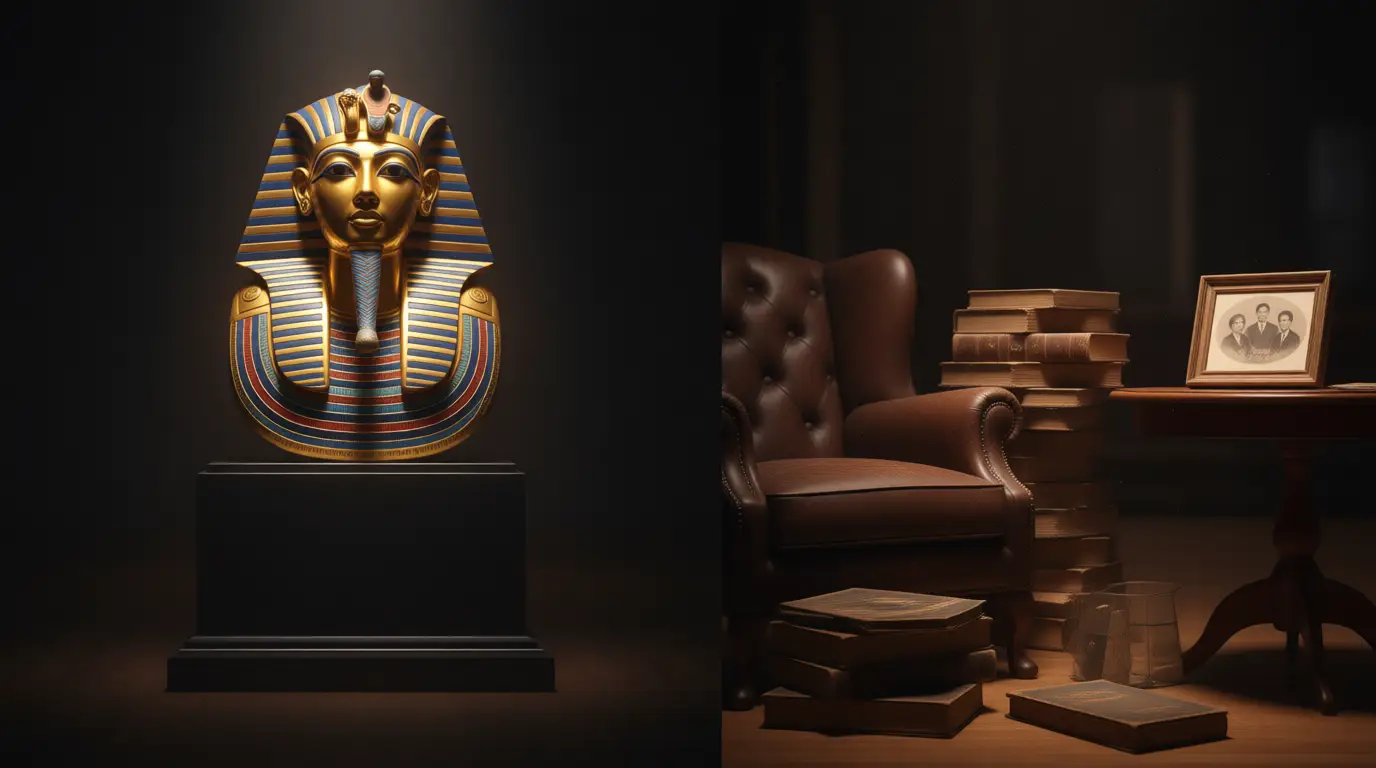
A soul has departed from the living earth. Where to, no one really knows. As her body warmth slowly fades and finally reaches zero, even her memories—once treasured souvenirs held close by those who loved her—begin to drift away from the spaces she once filled. In today’s world, the auction of a dead person’s belongings by their loved ones is treated as a regular, almost bureaucratic activity. Thousands of years ago, however, those very objects were carefully wrapped, blessed, and buried alongside the departed, sent into the afterlife as companions for a journey beyond the grave.
But in our cosmopolitan, overpopulated world, such practices no longer make sense. For one, there simply isn’t the space—neither in cemeteries nor in collective memory—to entomb every human with their possessions. Secondly, and perhaps more pressingly, it no longer aligns with our evolving ethics of sustainability and resource scarcity. In a world increasingly terrified of depletion—of water, of forests, of rare metals, of habitable land—it seems wasteful, even irresponsible, to bury what could be reused. And let’s be honest: who today has the means to build a Giza or a Taj Mahal? The era of monumental tombs is over, reserved only for myth and museums.
What can be reused should be reused. What can be sold should be sold. And in the calculus of modern pragmatism, there is no real ethical conundrum in that.
Well—of course, there are exceptions. And exceptional situations. If you were a world leader, a figure who altered the course of history, the world would guard and preserve everything you ever touched. Your eyeglasses, your walking stick, your handwritten notes—even your T-shirt—might one day rest behind climate-controlled glass. If you were an equal of Lenin, they might preserve not just your belongings, but your very body, suspended in formaldehyde as a relic of ideology. If you were larger than life, your legacy would outlive your breath, echoing through textbooks, documentaries, and museum halls.
Tutankhamun, that boy-king of ancient Egypt, likely never imagined becoming a global sensation more than three thousand years after his death. He probably never dreamed that schoolchildren in Quebec, farmers in Kenya, or retirees in Oslo would one day gaze upon his golden mask in awe. But such is the strange alchemy of history: some vanish completely, while others—by birth, fate, or the luck of undisturbed tombs—become eternal.
The personal property of a deceased person is legally called “fittings” or “chattels.” Distributing them among family or selling them at auction brings no legal challenge in most jurisdictions. But the sentimental weight—ah, that is another matter entirely. Such auctions are rarely just transactions. They are quiet tragedies, sad reminders of a constant echo we try hard to ignore: the truth that disturbs peace and births emotions far from joy. They are stark confrontations with the emptiness that haunts even the fullest life.
As children, lovers, partners, spouses, parents, grandparents, friends, or colleagues, humans play countless roles throughout their lives. In each, they accumulate objects: photographs tucked in albums, furniture chosen with care, souvenirs from distant trips, books annotated in the margins, trinkets that seem meaningless to outsiders but pulse with intimate meaning. All these possessions, in their quiet way, help construct identity. A carpet collector. A vase enthusiast. A lover of vintage typewriters. Even in the poorest of homes, you will find a framed family photograph—faded, perhaps, but fiercely protected. Each item tells a story; each completes a fragment of who that person was.
But once the body lies still—buried in a faraway cemetery or reduced to ash and scattered to the wind—the world begins to dismantle what took decades to build. Loved ones, often out of necessity or grief, slowly rip apart the world the deceased crafted. One by one, they sell the things that made a person: the reclining chair where she read poetry at dusk, the bookshelf groaning under philosophy and fiction, the kitchen tools seasoned by decades of meals. Eventually, even the house—the stage of so many memories—is sold, repainted, reoccupied by strangers who know nothing of the laughter that once echoed in its halls.
After a while, there is absolutely nothing left. No trace. No whisper. In a world where billions live and die—many unnoticed, many unrecorded—there simply cannot be billions of Tutankhamuns.
This is where the minimalist, perhaps, emerges as the quiet victor. A minimalist lives with what is necessary—not what is coveted out of greed or habit. They accumulate lightly, attach sparingly, and depart with little for the world to auction or mourn. But even while knowing this hard truth, most people will not choose minimalism. Why? Because if death is inevitable for all—rich or poor, ascetic or hedonist—then what difference does it truly make? When the nature of what lies beyond remains unknown, why suppress desire? Why deny the soul its cravings for beauty, comfort, or abundance?
And who, really, gave words like “greed” or “excess” such a bad name? If the core teachings of most religions urge simplicity, humility, and detachment from material wealth, then why do so many of their institutions shimmer with opulence? Why are cathedrals gilded, temples draped in gold leaf, and shrines adorned with gemstones? Is something fundamentally broken in the system—or has humanity simply grown comfortable with a sacred hypocrisy, one that has been passed down as tradition for centuries?
When humanity first organized into civilization, its architects had to imagine what order would look like. The first leaders were likely those who wielded physical strength—selfless or savage, depending on the telling—who fought not just rival tribes but the raw forces of nature: predators, droughts, floods. In those early days, humans were often prey. Against the lightning speed of the cheetah, the crushing jaws of the lion, or the coiled strike of the serpent, early humans stood little chance. Battles for water holes, for safe caves, for the carcass of an impala—these were usually won by tooth and claw, not by wit or will.
Then, one day, everything changed. A human—whose name we will never know—discovered fire. Not just found it, but learned to create it, control it, carry it. Fire became the first true technology, the spark that lit the path to everything that followed: cooking, metallurgy, protection, community. Fire redefined humanity’s place in the food chain. It was not the sword or the plow that built civilization—it was the flame.
Before fire, or perhaps just after its mastery, there were no organized religions as we understand them today. People likely worshiped what sustained them: the forest that gave fruit and shelter, the rain that fed their crops, the sun that coaxed life from barren soil. These were primal, poetic acts of gratitude—not dogma.
Organized religion, with its hierarchies, doctrines, and institutions, emerged later—likely not for the poor, the displaced, or the voiceless, but for those who sought to govern. Who benefits most from the “protection of divinity,” the “cover of the holy,” the “blessings of the almighty,” and the “endorsement of high priests”? Not the child dying of hunger in a war-torn village. Not the voter deceived by every election cycle. Not the migrant lost at sea.
It is the rulers—the kings, pharaohs, emperors, and elites—who need organized belief systems to maintain order, legitimize power, and shape the thoughts of the masses to suit their own designs. Religion became less about personal transcendence and more about social control—a divine mandate for inequality.
And so, when we place Tutankhamun’s intact treasures—his chariots, his sandals, his golden throne—next to the scattered chattels of an ordinary person sold for a few dollars at an estate auction, we see a timeless pattern. Life has always favored the rich and mighty. They live gloriously while alive, and even in death, they are remembered, preserved, celebrated.
While Toms, Dicks, and Harries see their names forgotten before the next harvest, their possessions scattered like dry leaves in the wind, it is only a Tutankhamun who rises—centuries later—from a hidden tomb to be placed in royal halls, his wealth untouched, his story retold.
Not because he was wiser. Not because he was kinder.
But because he was king.
And in this world, that has always made all the different

Dhanuka Dickwella is a distinguished Sri Lankan poet, author, and multifaceted professional whose work spans literature, geopolitics, and social activism. Holding a Master’s degree in International Relations, he has established himself as an expert in geopolitics and geoeconomics, fields that inform his analytical and creative endeavours.
His professional portfolio includes significant editorial and journalistic roles: he serves as the Executive Editor of The Asian Reviews magazine, a platform dedicated to bridging the literary worlds of East and West. Additionally, he contributes as a guest writer for the Chicago-based Armenian Mirror-Spectator, focusing on geopolitical issues in the Caucasus region, and as a columnist and guest speaker for Force, an Indian magazine addressing security and defense matters. Dickwella’s career in public service is equally notable. Dhanuka Dickwella is the Chief Coordinator for Canada for the Panorama International Literature Festival 2026. He has been actively involved in Sri Lankan politics, having served as a grassroots politician, political campaign director, and council member of a local government body in a rural Sri Lankan town. Prior to his political engagements, he founded and led a foundation dedicated to empowering youth and supporting underprivileged communities, reflecting his commitment to social equity. Currently, he advises youth groups on political activism and broader political trends, leveraging his extensive experience to foster the next generation of civic leaders. Beyond his analytical and political pursuits, Dickwella is a celebrated poet and blogger whose literary work explores the complexities of human emotion and experience. His debut poetry collection, Voices of Lust, Love and Other Things, showcases his ability to weave personal narrative with universal themes. An ardent climate and social activist, he champions sustainable development and social justice, driven by a vision of a better world for future generations. A proud Sri Lankan patriot, Dickwella is also a devoted father to his daughter, whose influence is a cornerstone of his personal and creative life. Dhanuka Dickwella’s diverse achievements reflect a rare synthesis of intellectual rigor, artistic expression, and civic dedication, positioning him as a prominent voice in both Sri Lankan and global contexts.
Leave a Reply