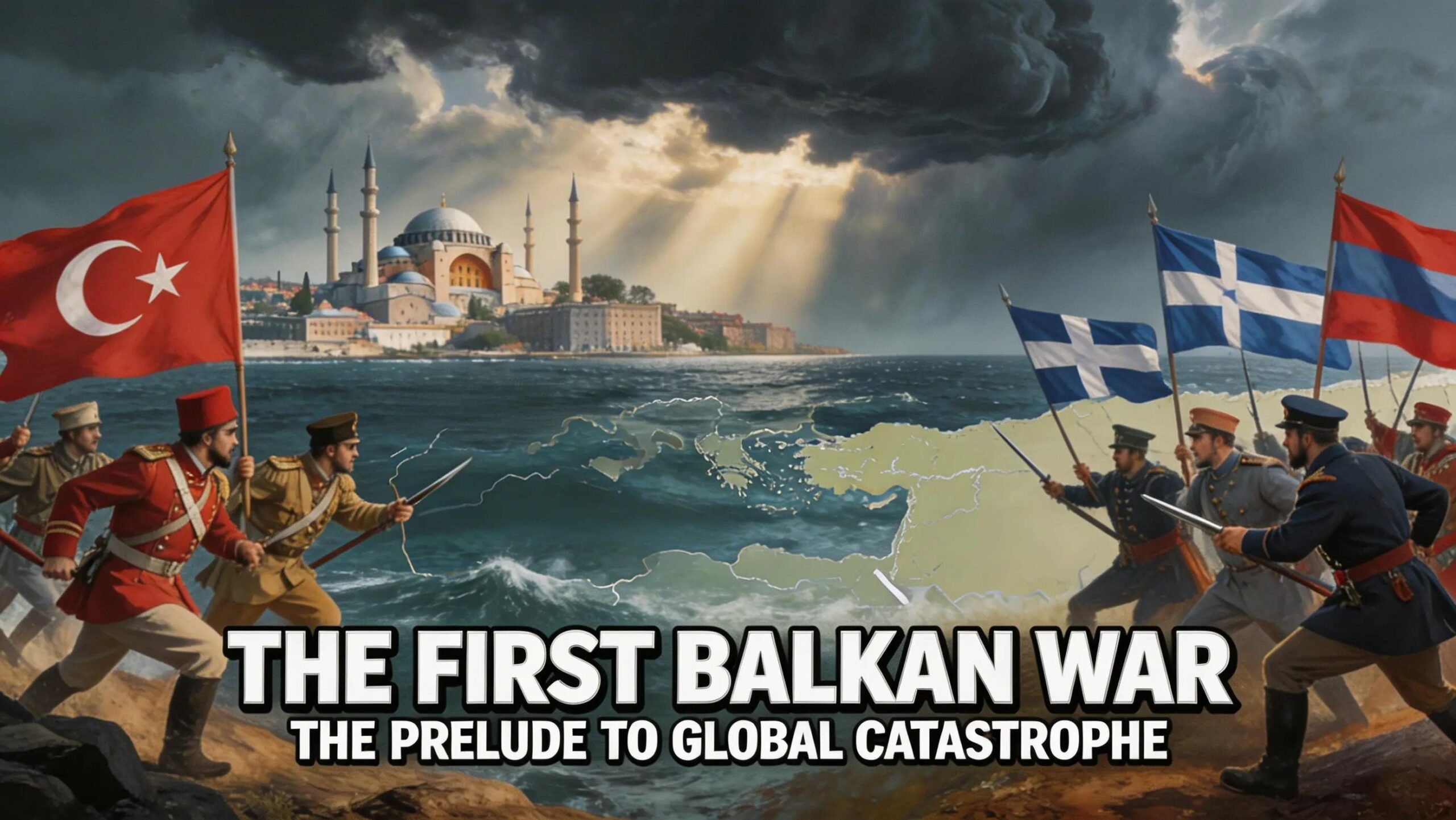
The Powder Keg of Europe: A Continent on the Brink
The First Balkan War was more than a local conflict; it was a seismic ideological shift in the European balance of power. By the early 20th century, the Ottoman Empire, long dominant in the Balkans, was derided as the “Sick Man of Europe.” Its decline was deep-rooted and hastened by the Italo-Turkish War (1911–1912) over Libya. Italy’s swift victory further revealed the Ottoman Empire’s fragility, signaling to the world that the Sultan’s European territories were vulnerable.
The Great Powers of Europe observed with predatory interest. Without a formal agreement to end Ottoman presence, they still coordinated to reset Europe’s power dynamics. Their interests overlapped but shared a focus: Constantinople. For Russia, it was the “Third Rome”; for Britain, the East’s gateway; for Germany, a new economic hub. The Balkans became the chessboard where empires and nationalisms collided.
The Imperial Chessboard: Powers and Provocations
The British Empire: The Cynical Observer
Historically, Great Britain was the “Protector of the Turks,” a role it played to ensure the Russian Empire never gained access to the Mediterranean through the Bosphorus. However, by 1912, British policy had shifted toward “Splendid Isolation” mixed with strategic cynicism. London’s primary concern was the Suez Canal and the maritime route to India. While they allowed the Balkan League to weaken the Ottomans—thereby undermining German influence in Istanbul—they maintained a massive naval presence to ensure that neither Russia nor a new Balkan power could threaten British naval hegemony.
The Russian Empire: The Pan-Slavic Architect
Russia was the primary catalyst for the conflict. Driven by the Pan-Slavic movement, St. Petersburg viewed itself as the “Big Brother” to the Orthodox Slavs. For Russia, the war was a proxy battle to achieve what centuries of direct warfare had failed to do: secure the Straits. By brokering the Balkan League, Russia aimed to establish a satellite block of nations that would drive the Turks out, effectively rendering the Black Sea a Russian lake.
The French Influence: Finance and Firepower
France played a paradoxical but pivotal role. French military doctrine and weaponry were the backbone of the Balkan League’s success. The Serbian and Bulgarian artillery were equipped with the famous French Schneider-Creusot guns, which proved far superior to the German Krupp cannons used by the Ottomans. Beyond firepower, Paris utilized “Gold Diplomacy.” French banks held much of the Ottoman debt, and Paris used this financial leverage to ensure that the “balance of power” did not shift so far toward Russia that it would destabilize French interests in the Mediterranean. There were financial loans available for multiple Balkan nations to strengthen their military muscle.
The German Empire: The Drang nach Osten
Germany was the “New Player” on the Ottoman side, focusing on the Berlin-to-Baghdad Railway. Germany invested heavily in training the Ottoman officer corps, led by General Colmar Freiherr von der Goltz. For Berlin, a strong Ottoman Empire was a bulwark against British and Russian expansion. The war became a humiliating trial for German prestige, as their trained troops and Krupp guns fell before the French-armed Balkan League backed by the Russians.
The Austro-Hungarian Empire: Existential Dread
For Vienna, the war was a nightmare. The Austro-Hungarian Empire feared that a “Greater Serbia” would act as a magnet for the millions of Slavs living within its own borders. They maintained a massive military presence on the Bosnian border, ready to intervene. It was the Austro-Hungarian demand for an independent Albania, specifically to deny Serbia access to the sea, that sowed the seeds of the bitter resentment leading to the 1914 assassination of Archduke Franz Ferdinand.
The Italian Kingdom: The Green Light
Italy was the catalyst. By successfully seizing Libya and the Dodecanese Islands in 1911, Italy proved that the Ottoman Navy was nonexistent. This “maritime invitation” convinced the Greeks that they could dominate the Aegean, effectively cutting off Ottoman reinforcements from Anatolia. Unless for Italy’s Libyan success, the first Balkan war might not have happened.
An Unlikely Miracle: The Balkan League and the Theaters of War
In a diplomatic feat that many considered a miracle, Russia helped unite the Greeks, Bulgarians, Serbians, and Montenegrins into the Balkan League. This was an “unholy alliance”; these nations had harbored deep-seated hatred for one another for centuries. Yet, they presented a united front to achieve a common goal: driving their arch-enemies out of Macedonia.
The war, beginning in October 1912, unfolded across three brutal theaters:
The Thracian Theater: The Bulgarian Army, known as the “Prussia of the Balkans,” launched a massive offensive toward Constantinople. At the Battle of Lule Burgas, the largest battle in Europe since 1870, they shattered the Ottoman Eastern Army. The Turks were pushed back to the Chataldzha defense line, just 30 kilometers from the capital.
The Macedonian Theater: The Serbian First Army met the Ottomans at the Battle of Kumanovo. Using superior French artillery and aggressive infantry tactics, the Serbians crushed the Ottoman Vardar Army, ending six centuries of Ottoman presence in the heart of the Balkans.
The Aegean Theater: The Greek Navy, led by the armored cruiser Georgios Averof, blockaded the Ottoman fleet in the Dardanelles. This prevented the Sultan from bringing his massive Anatolian reserves to Europe, leaving the Ottoman Balkan armies isolated and doomed.
The Aftermath: The Roots of Future Horrors
The Ottoman defeat had a decisive and tragic effect on the demographics of the empire. As the Ottomans lost Macedonia and Thrace, hundreds of thousands of Muslim refugees, ‘muhajirs’, fled the violence and poured into Anatolia. This massive displacement created a “security paranoia” within the Ottoman leadership. While a separate discussion is required for the Armenian Genocide, it is undeniable that the First Balkan War played a significant role in radicalizing the Young Turk government. The loss of European land made the empire turn inward, viewing its remaining Christian minorities, such as the Armenians and Greeks, through a lens of suspicion and “demographic engineering.”
The Curtain Raiser for World War I
Ultimately, the First Balkan War served as the “curtain raiser” for the First World War. It shattered the status quo and left the Balkan nations hungry for more territory. True to their history, the alliance quickly disintegrated; the victors shortly turned against one another in the Second Balkan War to divide the spoils of Macedonia.
The first shot in the final demise of the 600-year-old Ottoman rule had been fired. The regional instability created in 1912 and 1913, fueled by the competing interests of Great Britain, Russia, France, Germany, and Austria-Hungary, led directly to the assassination in Sarajevo. The Balkan front did not just change maps; it dragged the entire globe into the trenches. The First Balkan War was the spark that began the end of the old world order as we knew it.

Dhanuka Dickwella is a distinguished Sri Lankan poet, author, and multifaceted professional whose work spans literature, geopolitics, and social activism. Holding a Master’s degree in International Relations, he has established himself as an expert in geopolitics and geoeconomics, fields that inform his analytical and creative endeavours.
His professional portfolio includes significant editorial and journalistic roles: he serves as the Executive Editor of The Asian Reviews magazine, a platform dedicated to bridging the literary worlds of East and West. Additionally, he contributes as a guest writer for the Chicago-based Armenian Mirror-Spectator, focusing on geopolitical issues in the Caucasus region, and as a columnist and guest speaker for Force, an Indian magazine addressing security and defense matters. Dickwella’s career in public service is equally notable. Dhanuka Dickwella is the Chief Coordinator for Canada for the Panorama International Literature Festival 2026. He has been actively involved in Sri Lankan politics, having served as a grassroots politician, political campaign director, and council member of a local government body in a rural Sri Lankan town. Prior to his political engagements, he founded and led a foundation dedicated to empowering youth and supporting underprivileged communities, reflecting his commitment to social equity. Currently, he advises youth groups on political activism and broader political trends, leveraging his extensive experience to foster the next generation of civic leaders. Beyond his analytical and political pursuits, Dickwella is a celebrated poet and blogger whose literary work explores the complexities of human emotion and experience. His debut poetry collection, Voices of Lust, Love and Other Things, showcases his ability to weave personal narrative with universal themes. An ardent climate and social activist, he champions sustainable development and social justice, driven by a vision of a better world for future generations. A proud Sri Lankan patriot, Dickwella is also a devoted father to his daughter, whose influence is a cornerstone of his personal and creative life. Dhanuka Dickwella’s diverse achievements reflect a rare synthesis of intellectual rigor, artistic expression, and civic dedication, positioning him as a prominent voice in both Sri Lankan and global contexts.
Leave a Reply