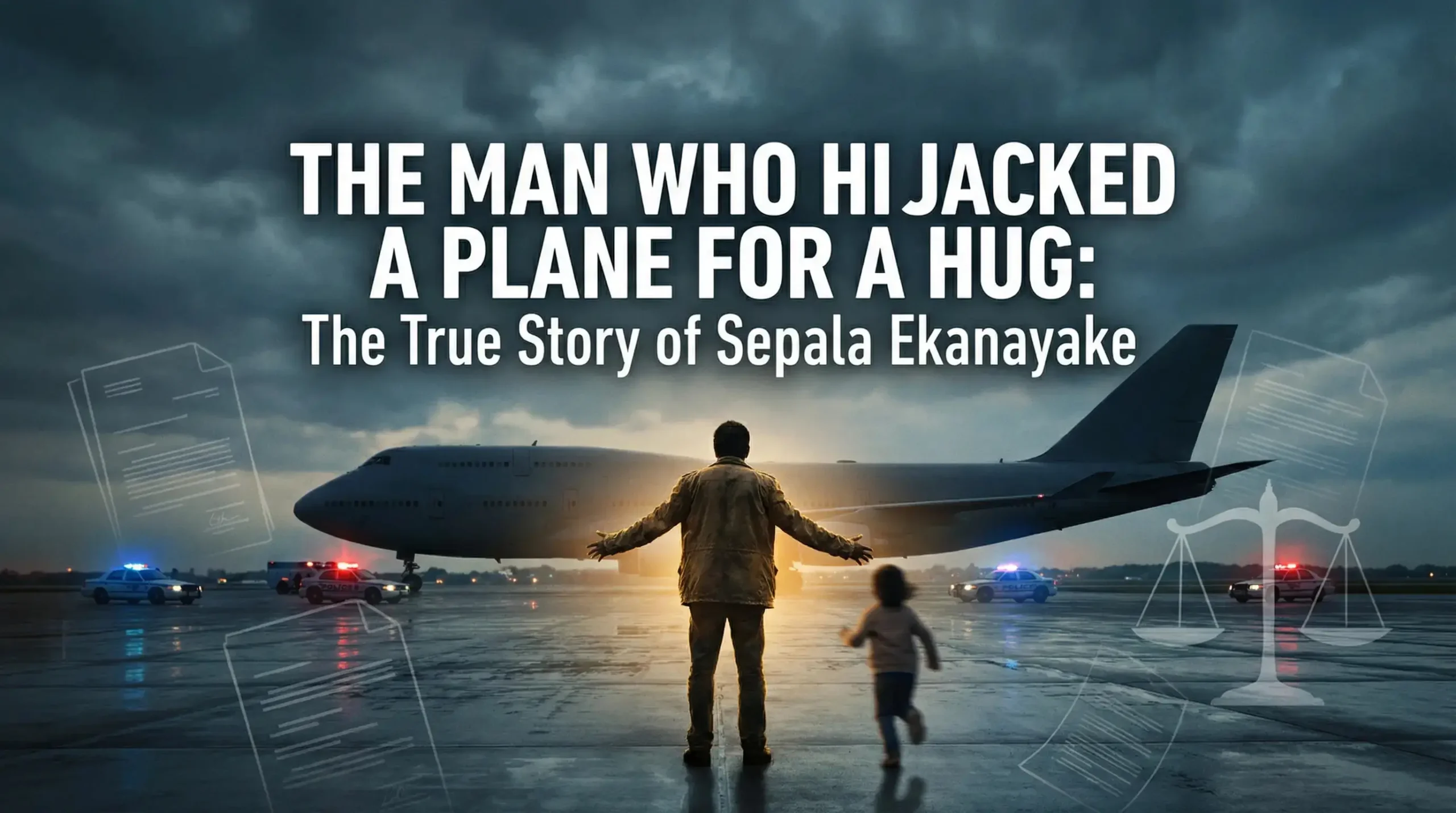
Plane hijacking is one of the most terrifying crimes that has occurred in the aviation domain. In the annals of aviation history, most hijackings are written in blood, ideology, or terror. Committed in the name of a flag, ideology, or a pledge of allegiance to a cause, it has always won the global spotlight. But one, probably the only one of its kind, was written in tears and committed in an act of paternal love.
On June 30, 1982, the world’s attention was seized by a young Sri Lankan man who achieved what few thought possible: he hijacked a commercial airliner for a purely personal cause and, for a brief moment, appeared to have won. But behind the folk-hero status that followed lay a complex web of legal loopholes, a desperate bluff, and a swift judicial reckoning that would change Sri Lankan law forever.
The Hijacking: 300 Lives for One Child
Sepala Ekanayake was a man pushed to the brink by a bitter family battle. His story starts in West Germany, where he met his future wife. The duo relocated to Italy upon marriage and having their one and only son. Soon, his visa expired. The authorities advised him to go seek a new visa from the embassy of Colombo. In Colombo, Sepala learnt that it would take him 6 years to obtain a visa to reunite with his family. Feeling abandoned by the Italian legal system and desperate to see his child, Ekanayake resorted to the most unthinkable act.
An Alitalia Flight 179 was on its way to Tokyo from Italy with a stopover in New Delhi. Sepala boarded the flight uneventfully but with a devious plan hidden in his mind. Armed with what he claimed was a sophisticated bomb, later revealed to be a radio and some wires, he seized control of the Boeing 747. His demands were singular: the flight had to be diverted to Bangkok, his son and his wife brought to him in Bangkok, and a ransom of $300,000, a safe passage to Sri Lanka. For over 30 hours in the stifling heat of the Bangkok airport, he held 300 plus passengers and crew as collateral for his paternal longing.
The Illusion of Victory
The Thai authorities and Alitalia eventually capitulated to prevent what they foresaw as a massacre unfolding. They also sought the assistance of the Sri Lankan state through its diplomatic mission. The Sri Lankan ambassador at the time happened to be the first female career diplomat in the history of Sri Lanka, a true career professional and a remarkable diplomat. Funny enough, she had dealt with a plane hijacking in Bangkok just two years ago. In 1980, an Indonesian plane was hijacked by Indonesian fundamentalists, and they wanted to come to Sri Lanka to refuel. Now she had to intervene to avert an international crisis. She managed to convince Sepala to release the women and children on the flight who were held hostage.
In a scene that would be immortalized in Sri Lankan culture, Ekanayake was reunited with his son and wife on the tarmac. To the spectators, it looked like a victory for the “underdog.” He released the hostages, secured the money, and was allowed to fly back to Sri Lanka as a free man. The Thai authorities failed to prosecute Sepala due to a confusion of communications.
Upon his arrival in Colombo, he was greeted with a hero’s welcome. Songs were composed in his honor, celebrating a father who had “conquered” the West. Sri Lanka media lionised him rather than objectively seeing the gravity of the crime he had just committed. But the celebration was premature.
The Legal Vacuum and the Arrest
The Sri Lankan government faced an immediate international crisis. They were under immense pressure from Italy and the global aviation community to punish Ekanayake or end up being branded as an ‘international pariah’ like Libya, which at the time was the favorite destination of flight hijackers. Yet they hit a wall: Sri Lanka had no laws at the time to prosecute a hijacker for an act committed outside its territory.
Sri Lankan police could not arrest him due to a lack of a very basic norm. There was no complaint lodged against him.Therefore, as an initial step to take action against Ekanayake, “some” complaint was required from an aggrieved party that would prima facie show that an offence had been committed, in order for the police to bear responsibility and order his arrest. Finally, the Italian ambassador made the complaint.
Ekanayake believed he was safe because of this loophole. However, the state found an immediate, albeit temporary, way to hold him. Upon his return, he was not initially arrested for hijacking, but for the possession of a large sum of foreign currency (the ransom money) for which he could not account. It was a tactical arrest, intended to keep him in custody while the government scrambled to fix the legal void.
The “Steel” of the Law: Article 13(6)
The transcript of the legal analysis reveals the extraordinary measures the state took. To ensure Ekanayake didn’t walk free, the Sri Lankan Parliament hurriedly passed the Offences against Aircraft Act No. 24 of 1982. The challenge was that the Constitution generally prohibits ex post facto laws (punishing someone for an act that wasn’t a crime when they committed it). However, the Supreme Court utilized Article 13(6) of the Constitution. This specific clause allows for trial and punishment for acts that, at the time they were committed, were “criminal according to the general principles of law recognized by the community of nations.”
By linking national law to international principles, the court validated a retroactive prosecution. Ekanayake was sentenced to five years in prison, setting a concrete legal precedent that Sri Lanka would never again be a safe haven for air piracy. He was released on licence nearly 9 months earlier from Mahara prison on 22nd March 1989.
A Final Declaration: The Cost of the Risk
While the human nature of Ekanayake’s desperation is undeniable, his story must stand as a stern warning rather than an inspiration. Hijacking a plane is never a solution.
Sepala Ekanayake gambled 300 innocent lives on a bluff. Had a single passenger panicked, or had a security team attempted a rescue, the result would have been a bloodbath. He may have held his son again, but he did so by traumatizing hundreds of families and forcing his own country to bend its constitutional will to punish him. He achieved his embrace, but he spent the prime of his life in a prison cell, proving that while a father’s love is powerful, the law is ultimately absolute.
Dhanuka Dickwella is a distinguished Sri Lankan poet, author, and multifaceted professional whose work spans literature, geopolitics, and social activism. Holding a Master’s degree in International Relations, he has established himself as an expert in geopolitics and geoeconomics, fields that inform his analytical and creative endeavours.
His professional portfolio includes significant editorial and journalistic roles: he serves as the Executive Editor of The Asian Reviews magazine, a platform dedicated to bridging the literary worlds of East and West. Additionally, he contributes as a guest writer for the Chicago-based Armenian Mirror-Spectator, focusing on geopolitical issues in the Caucasus region, and as a columnist and guest speaker for Force, an Indian magazine addressing security and defense matters. Dickwella’s career in public service is equally notable. Dhanuka Dickwella is the Chief Coordinator for Canada for the Panorama International Literature Festival 2026. He has been actively involved in Sri Lankan politics, having served as a grassroots politician, political campaign director, and council member of a local government body in a rural Sri Lankan town. Prior to his political engagements, he founded and led a foundation dedicated to empowering youth and supporting underprivileged communities, reflecting his commitment to social equity. Currently, he advises youth groups on political activism and broader political trends, leveraging his extensive experience to foster the next generation of civic leaders. Beyond his analytical and political pursuits, Dickwella is a celebrated poet and blogger whose literary work explores the complexities of human emotion and experience. His debut poetry collection, Voices of Lust, Love and Other Things, showcases his ability to weave personal narrative with universal themes. An ardent climate and social activist, he champions sustainable development and social justice, driven by a vision of a better world for future generations. A proud Sri Lankan patriot, Dickwella is also a devoted father to his daughter, whose influence is a cornerstone of his personal and creative life. Dhanuka Dickwella’s diverse achievements reflect a rare synthesis of intellectual rigor, artistic expression, and civic dedication, positioning him as a prominent voice in both Sri Lankan and global contexts.
Leave a Reply