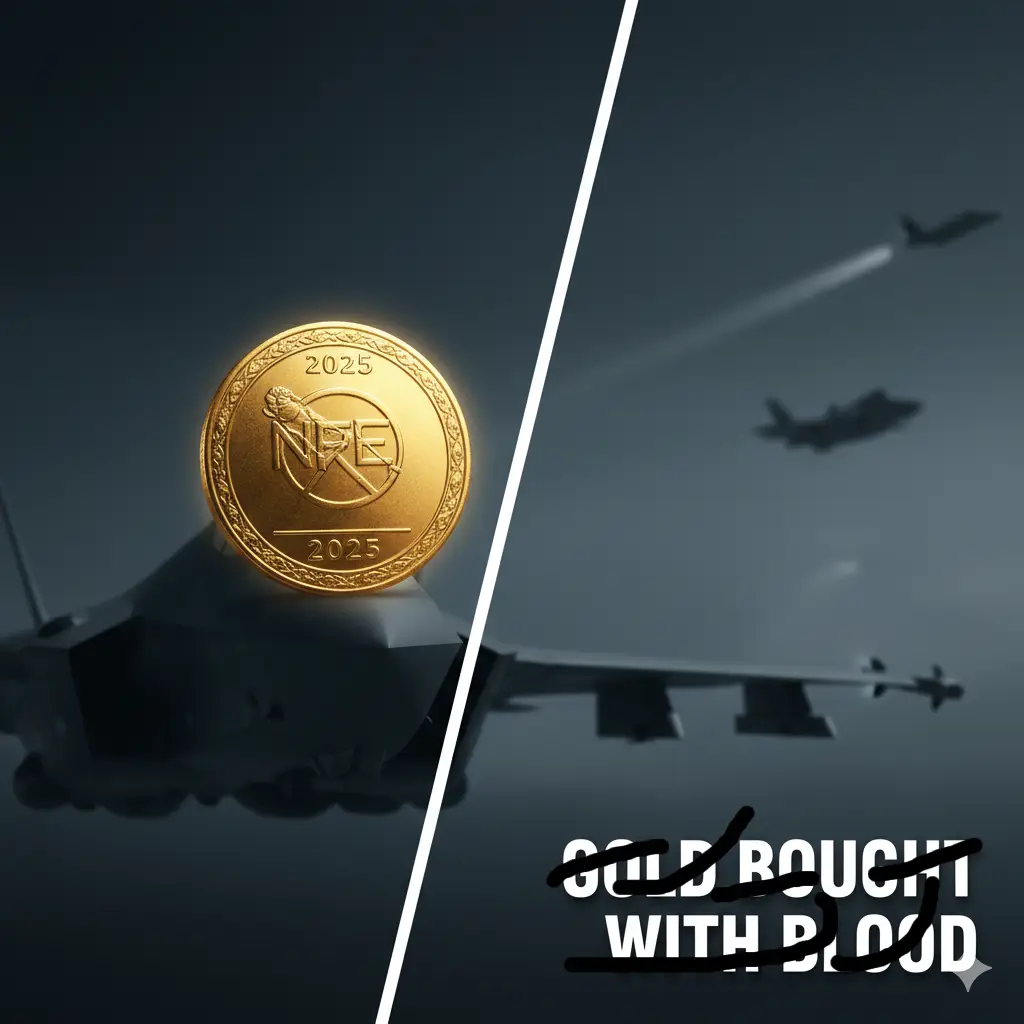
The Paradox of the Merchant of Death
It is a fact that Alfred Nobel’s legacy was built on a foundation of profound guilt. As the man who invented dynamite, his fortune was forged in the volatility of explosives that reshaped both the earth and the nature of warfare forever. His final will was a desperate attempt to stabilize a world he had inadvertently armed, seeking to honor the “exception”, the individual who conferred the “greatest benefit to humankind” by fostering fraternity and the reduction of standing armies.
When the Norwegian Nobel Committee shortlisted María Corina Machado in late 2025, they undoubtedly believed they were identifying an exceptional candidate. At least it appeared so. They saw a woman standing against a regime in Caracas that had long ago abandoned the pretense of democratic norms. But even before the ink dried on her citation, the reality of her ambition began to grind against the very essence of the peace she was ostensibly awarded for. The resulting friction has not just ignited Venezuela; it has incinerated the credibility of the Nobel institution itself. Let’s dive deep.
The Blood on the Gold: A Price Paid in Lives
Let us be clear: the government in Caracas under Nicolás Maduro was anything but a beacon of liberty. Criticism of the administration was not just valid; it was a global necessity. However, there is a distinct, dark line between being a democratic dissident and being a “Desperado” who invites foreign missiles to settle a domestic score.
When Machado was finally awarded the prize on October 10, 2025, a wave of outrage rippled through international circles. The allegation was chillingly simple: she had used her platform to openly call for external military intervention. She didn’t just ask for sanctions or diplomatic pressure; she asked for aggression. She asked for her own cities to be targeted and her own people to be placed in the crosshairs of a foreign superpower. A true virtue of a peace lover.
The tragedy is that her wish eventually came true. On January 3, 2026, the U.S. launched Operation Absolute Resolve, a massive military incursion involving over 150 aircraft and special operations forces. While the primary objective was the abduction of Maduro, the collateral damage was devastating. Nearly 100 lives were lost in the initial strikes, including security personnel and at least three civilians in residential areas like Baruta and El Hatillo. Those who died must have been the son of an innocent Venezuelan mother, the husband of a grieving wife, or the only guardian of elderly parents. These are the very same people whom Machado claimed she wanted to “save.”
In the eyes of history, Machado has blood on her hands. She is as responsible for those deaths as the executioners who pulled the triggers, for she provided the moral cover for the mechanical slaughter. She turned a prize for “fraternity between nations” into a marketing brochure for a naval blockade.
The Virtue of the Pariah: Assange’s Stand for Truth
While Machado’s actions were already a disgrace, the narrative took a sharper, more legalistic turn on December 17, 2025. Julian Assange, the journalist and whistleblower who has spent his life in confinement for the crime of transparency, has filed a criminal complaint against the Nobel Foundation in Sweden.
Assange is the ultimate counterpoint to Machado. He is a man who should have been awarded the Nobel for revealing the hidden machinery of war, yet his name was a poison pill to the global elites. His legal filing was not just an act of spite; it was a defense of the “Truth.” Assange argued that the selection of Machado converted an “instrument of peace into an instrument of war,” violating the fiduciary duty of the Swedish administrators to uphold Alfred Nobel’s will. By January 3, 2026, the world witnessed the validity of Assange’s argument in real time.
The contrast is nauseating: the man who revealed war crimes is treated as a criminal, while the woman who invited war, death, and destruction is treated as a saint. This inversion of values is the hallmark of our current geopolitical decay.
The Transaction: A Medal for a Kingmaker
The worst was yet to come. Having failed to secure the presidency through the chaos she invited, Machado performed the ultimate act of desperation. On January 15, 2026, she met with President Donald Trump at the White House and physically handed him her Nobel medal.
The question here is not the recipient of the gift, whether it was President Trump, the Pope, or Prime Minister Modi. The scandal lies in the intention. To Machado, the Nobel was not a sacred trust from humanity; it was a chip in a high-stakes poker game. She sought to trade the prestige of the medal for the power of political backing. In doing so, she shamed Alfred Nobel. She proved that she had long ago lost her soul, but she had no right to insult the rest of humanity by desecrating the prize on the altar of her own ambition.
The Norwegian Nobel Committee’s response was swift but impotent, stating that the prize “cannot be transferred.” Yet the image of the physical medal sitting on a desk in Washington, presented by a woman who prayed for the bombing of her own country, remains a permanent scar on the institution.
The Irony of the Usurper: The Rise of Delcy Rodríguez
In a final, bitter twist of irony, the “Desperado’s” prayer was answered, but the rewards were given to another. Although the military aggression Machado called for did indeed topple Maduro, the resulting power vacuum was not filled by her.
Instead, international players, including the very Trump administration she courted, moved to consolidate power under Acting President Delcy Rodríguez. In a world governed by “Realpolitik,” Rodríguez represented a predictable continuity that Machado, with her volatile calls for fire and blood, could not offer. On January 5, 2026, Rodríguez was formally sworn in, with even the U.S. acknowledging her as the head of “administrative continuity’’. It wasn’t just the Venezuelan Supreme Tribunal, but the country’s Military backed her, which was one logical argument for Washington to sideline Machado.
Machado, the woman who sold her soul to the glory of a foreign-backed coup, now finds herself a spectator. She is a laureate without a country and a leader without a medal. She bartered her dignity for a throne that was never intended for her.
Conclusion: The Desecrated Altar
The story of Machado the Desperado is a warning for the 21st century. It tells us what happens when our highest institutions become so brittle that they can be bought, sold, or bartered by those who seek power at any cost.
Alfred Nobel’s altar has been desecrated. The 2025 Peace Prize was not a benefit to humankind; it was a catalyst for conflict. Until we return to honoring the true exceptions, the Assanges of the world who speak truth to power regardless of the cost, the Nobel will remain a broken structure, a hollow shell that no longer protects the sanctity of human peace.
Watch the video here https://www.youtube.com/watch?v=3LbxOPmR5ts
Dhanuka Dickwella is a distinguished Sri Lankan poet, author, and multifaceted professional whose work spans literature, geopolitics, and social activism. Holding a Master’s degree in International Relations, he has established himself as an expert in geopolitics and geoeconomics, fields that inform his analytical and creative endeavours.
His professional portfolio includes significant editorial and journalistic roles: he serves as the Executive Editor of The Asian Reviews magazine, a platform dedicated to bridging the literary worlds of East and West. Additionally, he contributes as a guest writer for the Chicago-based Armenian Mirror-Spectator, focusing on geopolitical issues in the Caucasus region, and as a columnist and guest speaker for Force, an Indian magazine addressing security and defense matters. Dickwella’s career in public service is equally notable. Dhanuka Dickwella is the Chief Coordinator for Canada for the Panorama International Literature Festival 2026. He has been actively involved in Sri Lankan politics, having served as a grassroots politician, political campaign director, and council member of a local government body in a rural Sri Lankan town. Prior to his political engagements, he founded and led a foundation dedicated to empowering youth and supporting underprivileged communities, reflecting his commitment to social equity. Currently, he advises youth groups on political activism and broader political trends, leveraging his extensive experience to foster the next generation of civic leaders. Beyond his analytical and political pursuits, Dickwella is a celebrated poet and blogger whose literary work explores the complexities of human emotion and experience. His debut poetry collection, Voices of Lust, Love and Other Things, showcases his ability to weave personal narrative with universal themes. An ardent climate and social activist, he champions sustainable development and social justice, driven by a vision of a better world for future generations. A proud Sri Lankan patriot, Dickwella is also a devoted father to his daughter, whose influence is a cornerstone of his personal and creative life. Dhanuka Dickwella’s diverse achievements reflect a rare synthesis of intellectual rigor, artistic expression, and civic dedication, positioning him as a prominent voice in both Sri Lankan and global contexts.
Leave a Reply