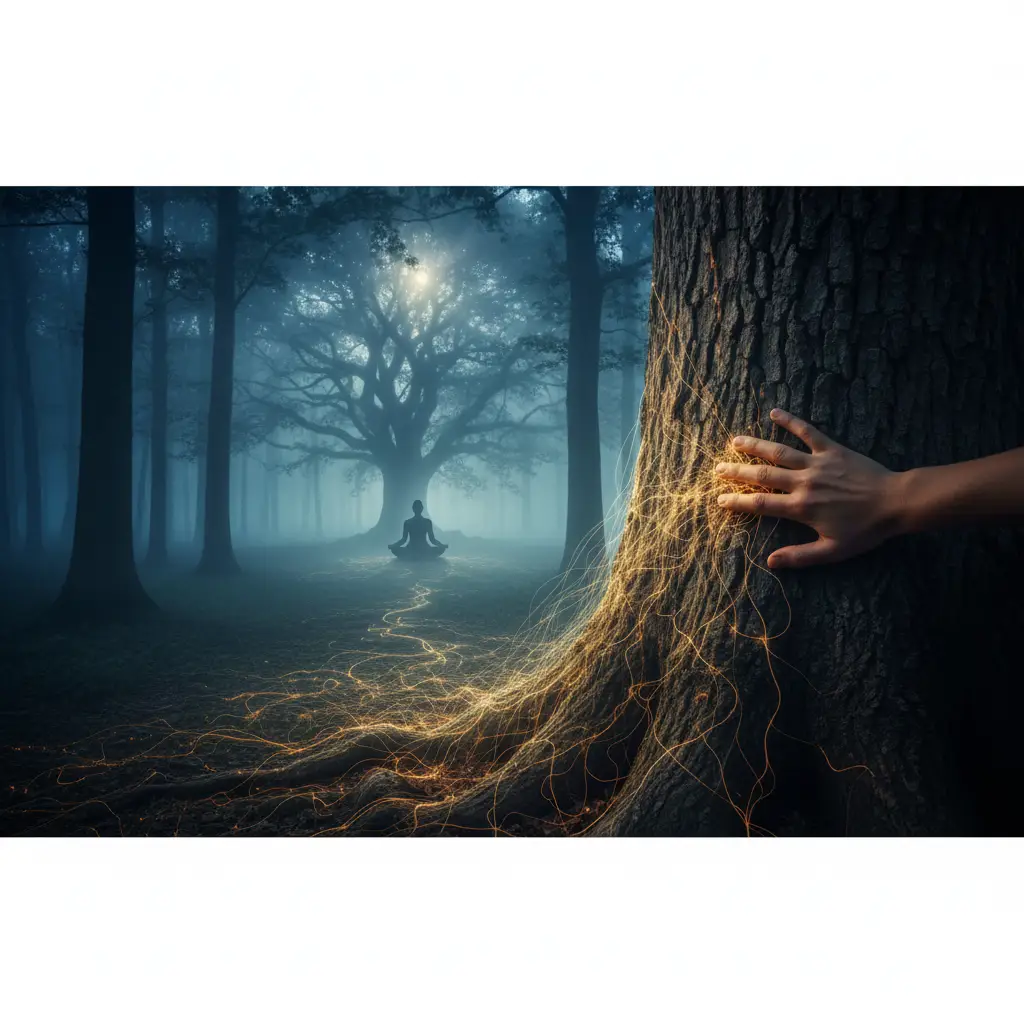
Can Trees Talk?
If the answer were a simple “yes,” we might have seen a 2000-year-old Oak tree singing about King Charlemagne at Eurovision, or perhaps a Kapok tree of the Amazon putting a fierce fight on a live TV debate. We might have even heard a Baobab tree from Africa describe its unique ecosystem to National Geographic. But we haven’t seen any of that.
Does this mean trees cannot talk?
Trees might not speak in the traditional sense, through a voice like us humans or animals. But communication is not limited to vocal cords or loud screams. It is far more subtle, stealthy, and complex. Think of a Blue Whale mother in the Pacific calling to her kin through sonar waves, or the migrant birds visiting Australia’s Kati Thanda-Lake Eyre, a lake that comes to life only once every three years. Think of spiders that send messages through tapping and vibrations. In essence, true communication transcends sound; it thrives in mystically hidden, invisible networks, silence, reciprocity, and ancestral wisdom.
Every living thing and every non-living object on this planet plays a crucial part in sustaining life on Earth. But one must observe carefully to grasp this. In hindsight, trees do talk. This has been proven both by modern science and ancient wisdom. All First Nations people held such a close relationship with the trees and the forests that housed them; it was spiritual, never transactional.
The Wood Wide Web: Nature’s Underground Internet
Science now confirms what ancient wisdom always carried. Trees not only communicate through the resins they produce, but they also conduct complex operations underground. This subterranean network is popularly known as the “WWW or the Wood Wide Web. A vast network of fungi and roots, right underneath. Through it, they send food, share resources, signal impending dangers, and even “hire” the services of animals and insects for survival.
The centuries-old “Mother Trees” go even further. They are capable of recognizing their own kin. Just like animal mothers, they care for their offspring. They pool resources specifically for their kith and kin, allowing them to grow by extending their root networks or blocking rivals from gaining ground.
Perhaps we have to now rephrase our original question from “Can trees talk?” to “Are we listening?”
The Sacred Relationship
Consider the simplest task of a tree: they absorb poisonous carbon dioxide and gives us back oxygen. Does this not sound like a guardian angel whose purpose is to ensure our safe existence? Despite our cruelty towards them for centuries, they continue to care for us. Ancient generations were perhaps not “scientists” in the modern sense, but they knew something far more profound about trees than we do. They bathed the trees, made offerings, spoke to them, prayed for them, and made deities out of them. Is it just the majestic and mystic nature of a tree that drove our ancestors into such relationships? Or did they know something way more profound!
Later societies ridiculed that knowledge. They looked down upon those who revered trees as “primitive pagans” or “uncultured idiots.” Eventually, we gave in, becoming “intellectuals” who believe trees are nothing more than carbon-sucking, immovable expendables or the tree worshipers, the ultimate insult to human intelligence.
The Bodhi Tree: A Legacy of Peace
Yet, some cultures retained these rituals. In Buddhist culture, the Bodhi tree is treated with deep reverence. It is worshiped as the sacred tree that allowed Siddhartha Gautama to attain Nirvana and become Gautama Buddha. To this day, Buddhists worship Bodhi trees that are saplings of the original tree in Bodh Gaya. In times of sickness, grief, or challenge, they tell their stories, pleas, and complaints to the tree. Often, they find closure and comfort there. At times, miracles come into their lives.
What role could a tree be playing in such a moment? Is it sharing the grieving man’s energy with the rest of the forest? Is it influencing the electromagnetic field of the human? Or does it somehow absorb our misfortunes, just as it happily absorbs our carbon dioxide, and give us back an ocean of positivity? Perhaps answers to this could be found through a spiritual group whose lives are interdependent with trees.
Why did yogis, sages, monks, and even musicians choose to find peace under trees?
What is the depth and subtlety of their relationships? Just like water that holds the oldest knowledge of our world, trees hold wisdom and truths in their rings that predate most civilisations.
Will we ever be able to tap into that vast knowledge base by changing how we look at trees?
Before probing deep space, should we not try to understand what’s hidden in the Wood Wide Web?
Have you found your tree?
Have you ever tried talking to a tree or hugging one when under stress? Do you have a special tree that knows your story and is kind to you? They may be our greatest therapists, healers, and magicians performing miracles in silence. Don’t let the world discourage you from making a deep connection with a tree. You may find more peace standing close to one than scrolling through a screen in a digital void.

Dhanuka Dickwella is a distinguished Sri Lankan poet, author, and multifaceted professional whose work spans literature, geopolitics, and social activism. Holding a Master’s degree in International Relations, he has established himself as an expert in geopolitics and geoeconomics, fields that inform his analytical and creative endeavours.
His professional portfolio includes significant editorial and journalistic roles: he serves as the Executive Editor of The Asian Reviews magazine, a platform dedicated to bridging the literary worlds of East and West. Additionally, he contributes as a guest writer for the Chicago-based Armenian Mirror-Spectator, focusing on geopolitical issues in the Caucasus region, and as a columnist and guest speaker for Force, an Indian magazine addressing security and defense matters. Dickwella’s career in public service is equally notable. Dhanuka Dickwella is the Chief Coordinator for Canada for the Panorama International Literature Festival 2026. He has been actively involved in Sri Lankan politics, having served as a grassroots politician, political campaign director, and council member of a local government body in a rural Sri Lankan town. Prior to his political engagements, he founded and led a foundation dedicated to empowering youth and supporting underprivileged communities, reflecting his commitment to social equity. Currently, he advises youth groups on political activism and broader political trends, leveraging his extensive experience to foster the next generation of civic leaders. Beyond his analytical and political pursuits, Dickwella is a celebrated poet and blogger whose literary work explores the complexities of human emotion and experience. His debut poetry collection, Voices of Lust, Love and Other Things, showcases his ability to weave personal narrative with universal themes. An ardent climate and social activist, he champions sustainable development and social justice, driven by a vision of a better world for future generations. A proud Sri Lankan patriot, Dickwella is also a devoted father to his daughter, whose influence is a cornerstone of his personal and creative life. Dhanuka Dickwella’s diverse achievements reflect a rare synthesis of intellectual rigor, artistic expression, and civic dedication, positioning him as a prominent voice in both Sri Lankan and global contexts.
Leave a Reply