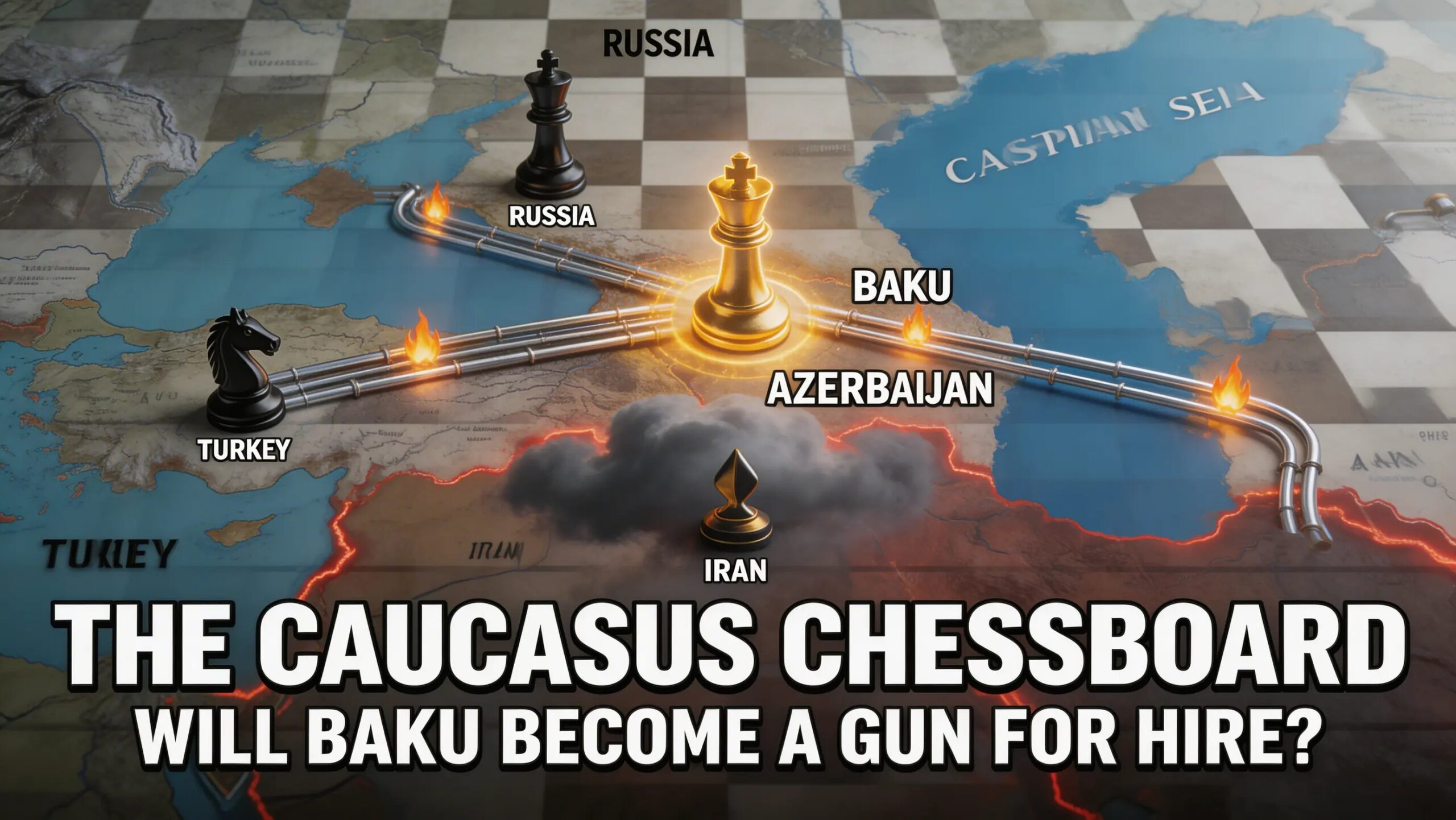
The warm relationship involving military, energy, and technological ties between Azerbaijani President Ilham Aliyev’s regime and the state of Israel is an open secret. Some of the weapons Aliyev used to expel the people of Nagorno-Karabakh (Artsakh) originated from Israel, most notably the Harop “suicide” drones, LORA quasi-ballistic missiles, and the SkyStriker loitering munitions. During the recent escalations between Israel and Iran, Azerbaijan has been accused of being a “silent partner.” As the US and Israeli military onslaught against Iran reaches a sharp and unexpected peak, there is significant talk that Aliyev would open a front against Iran, simply becoming a gun for hire.
The pretext is already materializing: the March 2026 alleged Iranian drone attacks on the Nakhchivan International Airport and the village of Shakarabad. Then the latest story of alleged Islamic Revolutionary Guard Corps (IRGC) spies.
What if the Azeris join this regional war? Before analyzing that, we must observe the four pillars for Aliyev that would determine survival.
Geography
Azerbaijan is a landlocked country bordered by its arch-enemy Armenia, an increasingly hostile Iran, a suspicious Russia, and friendly yet militarily weak Georgia, by land. It also has four maritime borders with Russia, Kazakhstan, Iran, and Turkmenistan in the Caspian Sea. Mind you, the Caspian Sea is an inland sea shared by the “Caspian Five” — Russia, Iran, Kazakhstan, Turkmenistan, and Azerbaijan. Russia and Iran have absolute dominance in the Caspian Sea. Its exclave, Nakhchivan, is a strategic nightmare, sandwiched between Turkey, Iran, and Armenia. Currently, the only reliable land access route to this exclave is through Iranian territory (the “Aras Corridor”). Furthermore, the Azeris at present cannot overfly or drive through Armenia. Its primary air connections to Europe must pass through Georgian airspace.
Economy
Baku is essentially a “gas and oil station” for Europe, but you need to know how it evolved. As a former Soviet republic, Azerbaijan was once the USSR’s crown jewel for energy. Hitler’s Army Group A made an unsuccessful dash for Baku’s oil fields and was annihilated by the Red Army on the Caucasus fields during the last century. After the dissolution of the USSR, Azerbaijan became a key hub for BP (British Petroleum). With the discovery of the Shah Deniz gas fields, it became a key gas supplier to Europe. Ever since, the economy has become a hostage to the Shah Deniz gas fields and the infrastructure that transports it.
The Baku-Tbilisi-Ceyhan (BTC) Pipeline carries nearly 30% of Israel’s oil imports. The South Caucasus Pipeline (SCP) is the core of the Southern Gas Corridor, which is critical for EU energy security.
According to IEA statistics, oil and gas account for roughly 90% of total exports and drive 50% of the state budget.
Military
First and foremost, Baku is a net military importer. Russia was its primary market. Then, with warming ties to Turkey, Ankara became its biggest partner. As gas money kept filling the coffers, Aliyev also diversified his shopping partners. Israel became a strategic and crucial supplier in that regard. But even Belarus and many other nations have been Baku’s military suppliers. It has a modest military and a modest air force. While it boasts a “battle-hardened” image from the 2020 and 2023 Karabakh operations, those victories relied heavily on Turkish F-16s, Bayraktar TB2 drones, Israeli intelligence, and Syrian Jihadists who were available as guns for hire.
Politics
Caucasus states have had many autocratic leaders, except for Armenia and Georgia at times. Azerbaijan is ruled by the Aliyev dynasty. First, it was Heydar Aliyev, once a senior KGB Politburo strongman. After his death, the junior Aliyev came to power. He, of course, conducts elections; they are neither free nor democratic. In every election, he wins nearly 90% of the vote while independent journalists and activists suffer in jail cells. UNHCR and many other organizations have been voicing concerns to no avail. When you sell gas to the democratic EU, you automatically become a democratic leader. That is how the current global order works. His entire family is also part of the administration, his wife being the vice president, for example.
The ‘Front Against Iran’ Scenario
Now that we have established the facts on the ground, let’s imagine Baku becomes a gun for hire and opens a front against Iran. Iran has proven to have zero mercy on its enemies and has not been modest in attacking economic lifelines. The BTC Pipeline, which provides oil to the EU, and the SCP, which provides gas to the EU, run through Georgia. None of that would last more than an hour once Tehran’s drones swam in.
The BTC and SCP pipelines are the only way Baku can realistically transport its energy supplies of 50 million barrels of oil per year and 12.8 to 12.9 billion cubic meters (bcm) of gas to the EU. The other option is the Russian connection through the Baku–Novorossiysk Pipeline (Northern Route), which can transport only 5 million oil barrels annually. In a nutshell, a single hour of Iranian missile strikes could evaporate Azerbaijan’s GDP for the next decade.
The Russian and Turkish Paradox
The Russian factor is the key here. Azerbaijan is not a part of the Collective Security Treaty Organization (CSTO) military club, the Russian version of NATO. This Russia-led security organization is duty-bound to defend its members, which includes Baku’s arch-rival, Armenia. Baku has been showing the middle finger to Moscow for a while, ever since the Ukraine war started. There has been much anger in Russia towards Baku, and it escalated into almost a hot conflict just last year. Putin has no reason to save Aliyev’s dynasty. Russia sees Iran as a much more vital ally that could determine its own strategic depth. Moscow will defend its most vital interest. Tehran giving a bloody nose to Aliyev will be well-tolerated by Moscow and its military. However, Moscow would want to retain a weakened and humbled Aliyev rather than a totally defeated one.
Turkey and Azerbaijan have been boasting about their relationship with the slogan “one nation, two states.” Historically, linguistically, or nationally, this rhetoric holds no ground. Baku and Ankara are supposedly military partners, and Turkey has to come to Azerbaijan’s help in the face of an attack. At least, this is a rumor that is commonly believed. But there is a problem: to save Baku from Iran, Turkey has to come through Iranian routes to attack Iran, as it is the only available land route. Armenian skies are guarded by Moscow; thus, there is no overflying.
Although Georgia could be open to such a deployment, it will not want to become a part of a war that will only bring death, destruction, and Moscow’s wrath. Twenty percetn of its lands are already occupied by Moscow, and Tbilisi will not want to take on another military adventure for which it has no means or budget.
In a worst-case scenario, if Tehran executes a leadership decapitation strike, as decapitation strikes are now an accepted method of warfare in Western military doctrine, Baku will plunge into an unknown fate. The reason is simple: its entire state architecture is based on a one-man power center. The judge-jury-prosecution-god-devil all in one.
If an analyst could perceive this dynamic and read the Caucasus chessboard, there is no doubt that the military strategists in Baku and Aliyev’s advisors might very well be advising him to keep badmouthing Tehran, yet stay the hell away from opening a salvo. If anything is true about this war, while you could fire the first shots, no one knows how and where it would end, and which region will go up in flames next. I have a feeling that Baku will not want to fight its last war and would stay away from becoming a gun for hire, at least for now.
See also this related video link: https://www.youtube.com/watch?v=TUu-WJAm_XM
Dhanuka Dickwella is a distinguished Sri Lankan poet, author, and multifaceted professional whose work spans literature, geopolitics, and social activism. Holding a Master’s degree in International Relations, he has established himself as an expert in geopolitics and geoeconomics, fields that inform his analytical and creative endeavours.
His professional portfolio includes significant editorial and journalistic roles: he serves as the Executive Editor of The Asian Reviews magazine, a platform dedicated to bridging the literary worlds of East and West. Additionally, he contributes as a guest writer for the Chicago-based Armenian Mirror-Spectator, focusing on geopolitical issues in the Caucasus region, and as a columnist and guest speaker for Force, an Indian magazine addressing security and defense matters. Dickwella’s career in public service is equally notable. Dhanuka Dickwella is the Chief Coordinator for Canada for the Panorama International Literature Festival 2026. He has been actively involved in Sri Lankan politics, having served as a grassroots politician, political campaign director, and council member of a local government body in a rural Sri Lankan town. Prior to his political engagements, he founded and led a foundation dedicated to empowering youth and supporting underprivileged communities, reflecting his commitment to social equity. Currently, he advises youth groups on political activism and broader political trends, leveraging his extensive experience to foster the next generation of civic leaders. Beyond his analytical and political pursuits, Dickwella is a celebrated poet and blogger whose literary work explores the complexities of human emotion and experience. His debut poetry collection, Voices of Lust, Love and Other Things, showcases his ability to weave personal narrative with universal themes. An ardent climate and social activist, he champions sustainable development and social justice, driven by a vision of a better world for future generations. A proud Sri Lankan patriot, Dickwella is also a devoted father to his daughter, whose influence is a cornerstone of his personal and creative life. Dhanuka Dickwella’s diverse achievements reflect a rare synthesis of intellectual rigor, artistic expression, and civic dedication, positioning him as a prominent voice in both Sri Lankan and global contexts.
Leave a Reply