The invisibles
Hassan Nasrallah and Lebanese Hezbollah made news every year. They were not limited to Israeli and Lebanese affairs. Hezbollah was all over the Levant and the Middle East. Their presence was felt globally in a number of theatres.
The image was surreal. An underdog force born out of a war of survival that grew into the most effective, formidable, and undefeatable military front of the entire Shia movement. They fought alongside Assad’s Syrian forces in the Aleppo hills, they fought alongside Iraqi paramilitaries against ISIS on the trenches of Mosul, they fought Northern Israel, all over Israeli airspace, cyberspace, and wherever Israel had its interest. The news channels kept lionising Nasrallah and the might of his 120,000 rocket forces that might destroy Israel in the event of a war; they glorified the Radawan forces, aka the Hezbollah commandos. Simply, Hezbollah was an undefeated force armed to the teeth with air, land, naval, cyber, and cross-border capacities.
Reality
Then the unthinkable happened. Nasrallah was killed mercilessly in the heart of Beirut. None of the top ten Hezbollah commanders survived Israel’s reach. Each of the top-notch leaders was targeted and killed. The war between Israel and Hezbollah that the whole world feared happened. But the mighty Hezbollah rockets did not rain all over Israel. Yes, there were many Israeli military casualties and damages worth millions. But none of it made a dent in diminishing the Israeli military capacities, nor its political decision-making. Hezbollah was forced to accept a ceasefire. Although unfavourable, that was the only choice given the moral, material, and military damage it had incurred.
The ceasefire was a strategic blow to Hezbollah’s very existence. Militarily, they have been forced out of the immediate region between the Litani River and the Israeli border, where they were able to pose a direct threat to the state of Israel. Their arsenals, tunnels, and other military structures were dismantled.
The political blow is far worse. While the state of Lebanon has acknowledged as the only military force able to bear arms are its military, from 1989 to the last government before the ceasefire, there was a clause that de facto accepted the existence of Hezbollah along with the country’s official military, with one specific term that kept continuing after every government. To be precise, the term ‘’ resistance’’. This was the one term that kept Hezbollah as a de facto part of the Lebanese state structure. But the last of ‘’The government’s ministerial statement’’ missed out on that term. While this is a mere symbolic action for an outsider, in Lebanese political cycles, the words meant more than their letters. A clear defeat for Hezbollah that could force them to be disarmed and even allow the state of Lebanon to directly negotiate with the state of Israel.
Post ceasefire
A year plus has passed since the ceasefire. Despite the conditions, every time a Hezbollah member surfaces somewhere, Israel does not think twice before killing them. The reaction? A media statement and angry verbal cry. Those deaths won’t make it even beyond Lebanese news cycles. In all fairness, we could say that Hezbollah has been humbled by the IDF and its political establishment.
Surely they are not done with, and in the long run, they may very well come back several-fold stronger and grow into what they once used to be. But that is a path that runs through an ever-watchful Israel and a host of hostile Sunni powers around them. Their great backers in Tehran are under constant pressure with a looming do-or-die war on the horizon. The Syrian patron is in exile in Moscow. The brothers in arms in Yemen, the Houthis, have silenced their guns. Under the administration of President Trump, a resurgent Hezbollah is not even a wishful thought. But given their history, we would have to agree that they will reappear at some point unless they are integrated into the democratic political force sans guns or admitted to the Lebanese armed forces through a PMF (Popular Mobilisation Force, aka Auxiliary Force ) Law like in Iraq.
The gametheory
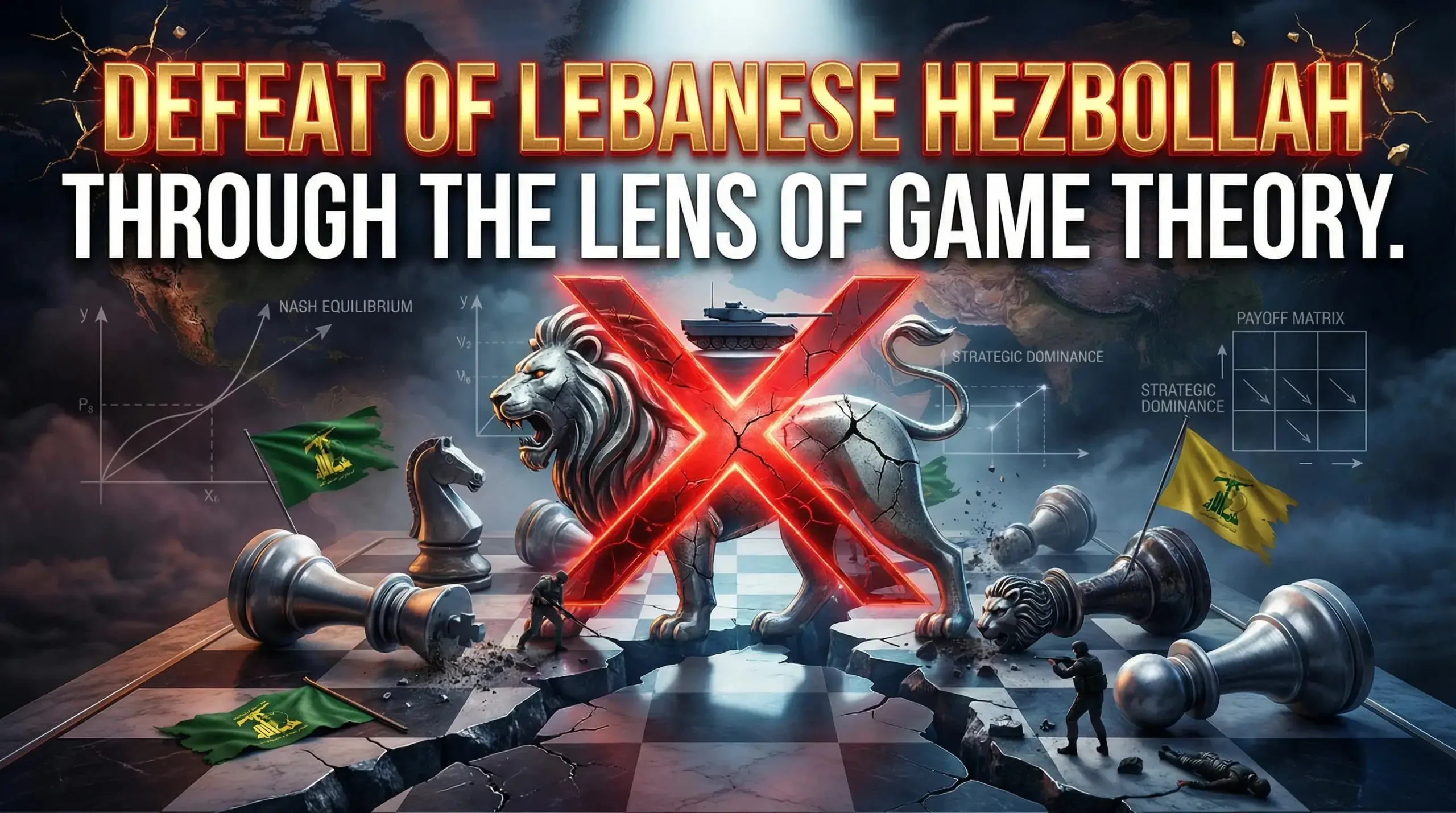
What happened to the mighty Hezbollah? This is where game theory applies. At the beginning, before the apocalyptic fate was met by Hezbollah, they maintained a mutual deterrence with Israel. If Tel Aviv fired one bullet, Hezbollah returned with one. If Tel Aviv fires a 155m cannon, Nasrallah returns the favour. Israel guns down a Hezbollah member, and they hunt an IDF soldier. A sort of Nash Equilibrium’’ in military terms, that prevented a third Lebanese war.
This mutual deterrence was quite simply an absence of war. It was never an eternal peace. Yet it worked for the time being. The Nash Equilibrium existed because both Israel and Hezbollah assumed the cost of “Total War” was higher than the benefit of any single victory.
Hassan Nasrallah’s decision to intervene on the side of Hamas was what changed the whole theater. Very clearly, it was not Hezbollah’s war to fight, and Tel Aviv probably expected Nasrallah to maintain his cold peace with Israel. But when he tried to exploit the difficulties Israel was facing, the IDF decided to call his bluff. The whole game theory comes right after.
The IDF executed the Pager attack. That clearly indicated “Point of No Return.” In Game Theory, this is the “First Move” in an escalation game where Israel signaled it no longer feared the “cost” of the Nash Equilibrium. The world expected Nasrallah to launch a devastating attack, but he decided to go soft with a few launchers, which were brought down by the IDF. Then the killing spree of the top leadership happened. Every such death was met by a few symbolic launches and a fierce speech given by Nasrallah. For the first time, his actions became quite predictable, a bark without a bite. That did not just embolden Israel but gave them a clear path for victory. Israel kept upping its ante while Hezbollah kept its response on a downward spiral. Finally, Nasrallah was killed, bringing his mystical invisibility to an end. Israel’s decision to hedge the risks associated with it by climbing the escalation ladder finally paid off.
The Lebanese front has fallen silent. The only guns that remain loaded and pointed are those of the IDFs. The only guns that go off in Lebanon are those of the IDF. Once mighty Hezbollah has been humbled and forced to silence. How long they will endure, how long they sustain, how long they are going to tolerate this grandiose humiliation remains to be seen. In a nutshell, the Levant will remain a powderkeg that is awaiting the beginning of the next cycle of violence.
Dhanuka Dickwella is a distinguished Sri Lankan poet, author, and multifaceted professional whose work spans literature, geopolitics, and social activism. Holding a Master’s degree in International Relations, he has established himself as an expert in geopolitics and geoeconomics, fields that inform his analytical and creative endeavours.
His professional portfolio includes significant editorial and journalistic roles: he serves as the Executive Editor of The Asian Reviews magazine, a platform dedicated to bridging the literary worlds of East and West. Additionally, he contributes as a guest writer for the Chicago-based Armenian Mirror-Spectator, focusing on geopolitical issues in the Caucasus region, and as a columnist and guest speaker for Force, an Indian magazine addressing security and defense matters. Dickwella’s career in public service is equally notable. Dhanuka Dickwella is the Chief Coordinator for Canada for the Panorama International Literature Festival 2026. He has been actively involved in Sri Lankan politics, having served as a grassroots politician, political campaign director, and council member of a local government body in a rural Sri Lankan town. Prior to his political engagements, he founded and led a foundation dedicated to empowering youth and supporting underprivileged communities, reflecting his commitment to social equity. Currently, he advises youth groups on political activism and broader political trends, leveraging his extensive experience to foster the next generation of civic leaders. Beyond his analytical and political pursuits, Dickwella is a celebrated poet and blogger whose literary work explores the complexities of human emotion and experience. His debut poetry collection, Voices of Lust, Love and Other Things, showcases his ability to weave personal narrative with universal themes. An ardent climate and social activist, he champions sustainable development and social justice, driven by a vision of a better world for future generations. A proud Sri Lankan patriot, Dickwella is also a devoted father to his daughter, whose influence is a cornerstone of his personal and creative life. Dhanuka Dickwella’s diverse achievements reflect a rare synthesis of intellectual rigor, artistic expression, and civic dedication, positioning him as a prominent voice in both Sri Lankan and global contexts.
Leave a Reply