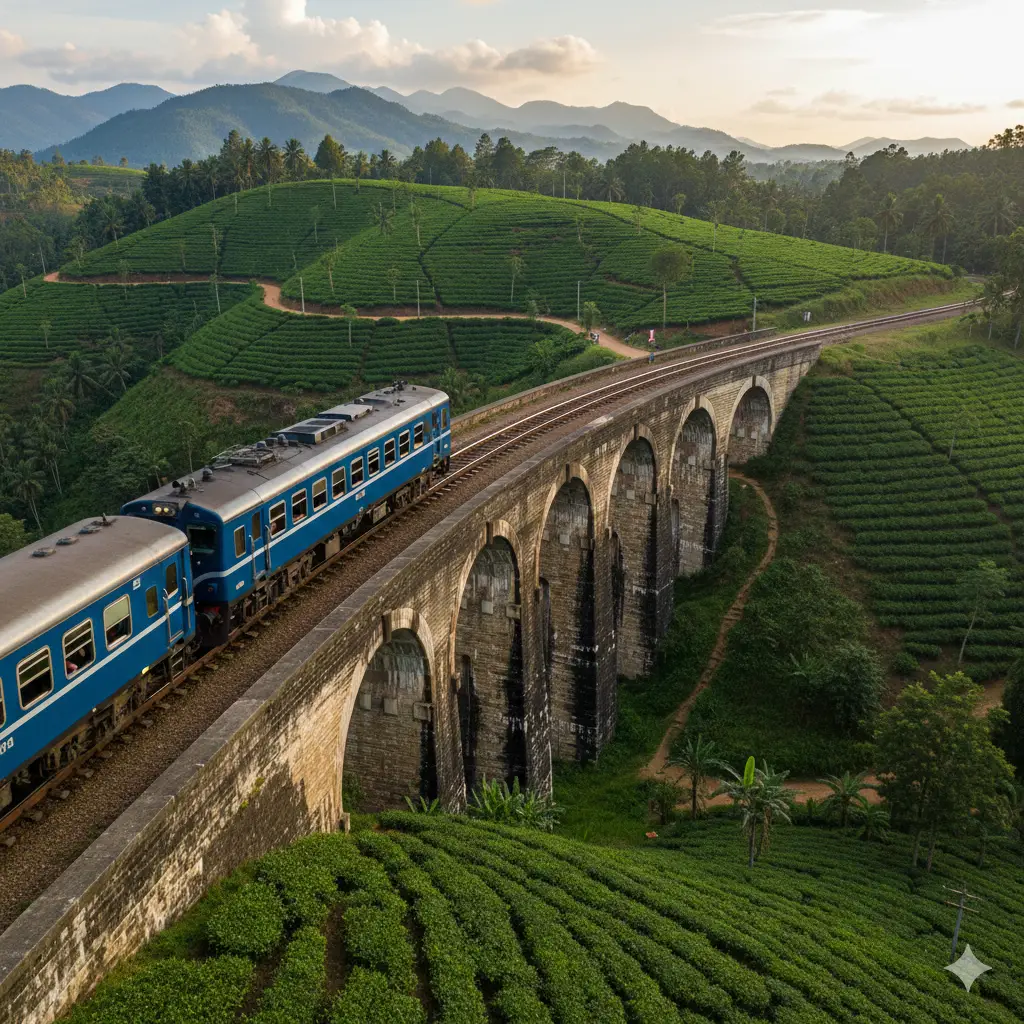
The story of the railway in Sri Lanka, formerly Ceylon, is not a story of public service, but one of strategic extraction and colonial engineering. It is a legacy carved into the granite of the central highlands and laid across the tropical plains, born from the British thirst for monopoly and the industrial transformation of a sovereign island into a commercial plantation. To understand the modern Sri Lankan railway, one must first look at the 19th-century British Ceylon, which forever altered the heart of the island’s natural landscape.
The Genesis: Spices, Coups, and Commodities
Before the 19th century, the Kandyan Kingdom remained an impenetrable fortress of biodiversity. Protected by steep mountains and dense rainforests, the heart of the island was ecologically shielded by royal decrees that preserved catchment areas. However, after the British consolidated power through the 1815 Kandyan Convention, a transition facilitated by internal political maneuvering, the landscape began to shift. The British viewed Ceylon not as a home, but as a strategic hub and a resource vault.
Strategically located in the center of the East-West trade routes, the island offered natural harbors like Trincomalee and Galle. Commercially, it offered spices, pearls, and gems. But the true catalyst for the railway was the “Green Gold”, first coffee, and later, Tea and Rubber. To transport these massive quantities of commercial goods from the interior to the Colombo Port for global export, the bullock cart was no longer sufficient. The Colonial government required a high-capacity, reliable, and uninterrupted transport system. Thus, the Ceylon Government Railway (CGR) was born, with the first sod being turned by Governor Sir Henry Ward in 1858.
Engineering the Ascent: Gauges, Tracks, and Engines
The construction of the railway was a feat of Victorian engineering, often referred to as “The Impossible Railway” when it reached the mountains.
The Broad Gauge Standard: Unlike many colonial outposts that used narrow gauges to save costs, the primary lines in Sri Lanka were built using the Broad Gauge ($5′ 6″$). This allowed for larger, more stable carriages capable of hauling heavy loads of tea and machinery through treacherous terrain. Narrow Gauge ($2′ 6″$): Certain feeder lines, most notably the “Kelani Valley Line,” were originally built as narrow gauge to navigate tight urban corners and specific plantation reaches, though most were later converted or abandoned.
Locomotives: The era was dominated by British-built steam locomotives. Manufacturers like Hunslet, Robert Stephenson and Hawthorns, and Vulcan Foundry supplied the island with the “iron horses” that could handle the 1:44 gradients (a rise of 1 foot for every 44 feet of track) in the highlands. Infrastructure: The tracks were laid using heavy timber sleepers (often sourced from the very forests the British were clearing) and iron rails. The construction of the Main Line required the drilling of dozens of tunnels through solid rock and the building of massive stone viaducts, such as the famous arches in the Demodara region and Ella.
The Peak of Empire: A Global Benchmark
At its zenith in the early 20th century, the Ceylon Government Railway (CGR) was not merely a local success; it was one of the most profitable colonial enterprises in the British Empire. By the 1920s, the network had expanded to its maximum reach, spanning over 1,500 kilometers (approx. 950 miles) of track, connecting the furthest corners of the island.
The scale of the operation was immense:
Workforce: The CGR became the largest employer in the country, with over 25,000 employees, creating a new middle class of station masters, engineers, and clerks.
Fleet: At its peak, the tracks were serviced by over 250 steam locomotives, ranging from heavy mountain haulers to sleek coastal express engines.
Profitability: In terms of revenue per mile, the Ceylon railway consistently outperformed colonial railways in India and Africa. The “Tea Traffic” was so lucrative that the railway’s profits often funded other colonial infrastructure projects across the island, making it the financial backbone of the British administration.
Social Impact: Forced Labor and New Horizons
The human cost of this “Steel” infrastructure was significant. Under the Road Ordinance of 1848, the British enforced a “poll tax” which required locals to either pay a fee or provide six days of free labor on roads and railways. This effectively forced the local peasantry into hard labor to build the very tracks that were clearing their ancestral lands. The tax gave birth to the Ceylon labour movement under the leadership of E. A. Gunasinghe, which translated into a major anti-colonial political force in the Island’s struggle for independence.
However, the railway also triggered a social revolution.
The Rise of the Commuter: For the first time, people from remote villages could travel to Colombo for education and government jobs.
Economic Micro-climates: Every station became a hub for local trade. Small-scale farmers who were previously isolated could now send vegetables, fruits, and dairy to urban markets. The “Railway Town” became a staple of Sri Lankan geography, creating new economic opportunities for those who lived along the line.
The Fortress Isle: Railway in World War II
During the Second World War, the Ceylon Railway was transitioned from a commercial tool to a vital military asset for the Allied forces. Following the fall of Singapore, Sri Lanka became the headquarters for the South East Asia Command (SEAC).
Logistics of War: The railway became the primary artery for transporting thousands of Allied troops from the ports to the inland garrisons. More importantly, as the Japanese occupied the rubber-rich regions of Southeast Asia, Sri Lanka became the Allies’ primary source of rubber. The railway ran 24/7 to transport “Steel and Rubber” to the ports to sustain the war effort.
The Easter Sunday Raid: On April 5, 1942, the Japanese “Kido Butai” launched an air raid on Colombo (known as the Easter Sunday Raid). While the railway workshops in Ratmalana and the Maradana station were high-priority targets, the infrastructure survived relatively intact, allowing the railway to continue its service as the “lifeline of the Indian Ocean” until the war’s end. However, the chosen targets highlight the vitality of the Ceylon Railway in British military operations.
The Architecture of Tradition: British Customs in the Modern Era
Perhaps the most striking aspect of the Sri Lankan railway is its role as a “living museum.” Even in 2026, the system operates on 19th-century British protocols that have remained virtually unchanged for over 150 years.
The Tablet System (Tyere’s Tablet Apparatus): To prevent head-on collisions on single-track lines, the railway still uses a mechanical “token” system. A driver cannot enter a section of track without a physical metal tablet, which is exchanged at each station. It is a fail-safe, non-electric method of traffic control that is a marvel of Victorian logic.
Video Link -https://www.youtube.com/shorts/v30jpHCq6wQ
Semaphore Signaling: While many countries have moved to digital LED signaling, many Sri Lankan stations still use the tall, iron lattice semaphore arms. These are operated manually by long wire pulls from a signal cabin.
Video Link https://www.youtube.com/watch?v=SMJ_vWQ0kVU
Station Architecture: From the Victorian-Gothic style of the Colombo Fort Station to the quaint, English countryside aesthetic of the Bandarawela and Nuwara Eliya (Nanu Oya) stations, the physical buildings maintain the red-brick and timber-framed charm of the British era.
Video Link https://www.youtube.com/watch?v=v3v2K8AFeUI
The Station Master: The hierarchy and even the uniforms, crisp white tunics, peaked caps, and the ceremonial use of green and red flags, are direct descendants of the Great Western Railway customs.
Growth and the Environmental Toll
As the plantations expanded, so did the tracks. The railway stretched north to the garrisons of Jaffna, east to the strategic port of Trincomalee and the rice-growing regions of Batticaloa, and south to the coastal fortress of Galle. However, this growth came at a staggering environmental cost. The “Royal Decrees” of the Sinhalese kings, which protected the highlands to ensure water security for the entire island, were ignored. The British “Waste Lands Ordinance” allowed the colonial government to seize any land that wasn’t “permanently cultivated.” This led to the mass clearing of primary rainforests to make way for tea and the tracks that carried it. The biodiversity sensitivity of the central hills was sacrificed for the industrial revolution’s demand for rubber and the European elite’s demand for tea.
The Decline: Roadways and Free Markets
The dominance of the railway began to wane in the mid-20th century. When the British left in 1948, they left behind a pristine system, but the global shift toward road transport began to take hold. The most significant blow came with the 1977 introduction of the Free Market Economy. As the economy opened, the importation of private vehicles, trucks, and buses surged. Roads were expanded and paved, offering “door-to-door” delivery that the rigid tracks of the railway could not match. The railway, once a profitable colonial tool for extraction, became a subsidized state service. Underinvestment in new locomotives and the aging of the British-era tracks led to slower travel times and a decline in cargo volume. By the late 20th century, the railway was no longer the primary mover of tea; that role had been taken by the heavy trucks of the private sector. The railway moved into a state of “stagnant service”, essential for the daily commute of thousands of workers, but struggling to modernize.
Conclusion: The Steel Legacy
The colonial railway of Sri Lanka was built to “rob” the island of its natural wealth, yet in doing so, it created a skeleton of connectivity that still holds the country together. It is a system of contradictions: built on the destruction of forests yet now providing the most eco-friendly way to see them; designed for cargo, yet now beloved by passengers. The “Steel” remains, ancient, British, and unyielding, waiting for the next chapter of modernization.

Dhanuka Dickwella is a distinguished Sri Lankan poet, author, and multifaceted professional whose work spans literature, geopolitics, and social activism. Holding a Master’s degree in International Relations, he has established himself as an expert in geopolitics and geoeconomics, fields that inform his analytical and creative endeavours.
His professional portfolio includes significant editorial and journalistic roles: he serves as the Executive Editor of The Asian Reviews magazine, a platform dedicated to bridging the literary worlds of East and West. Additionally, he contributes as a guest writer for the Chicago-based Armenian Mirror-Spectator, focusing on geopolitical issues in the Caucasus region, and as a columnist and guest speaker for Force, an Indian magazine addressing security and defense matters. Dickwella’s career in public service is equally notable. Dhanuka Dickwella is the Chief Coordinator for Canada for the Panorama International Literature Festival 2026. He has been actively involved in Sri Lankan politics, having served as a grassroots politician, political campaign director, and council member of a local government body in a rural Sri Lankan town. Prior to his political engagements, he founded and led a foundation dedicated to empowering youth and supporting underprivileged communities, reflecting his commitment to social equity. Currently, he advises youth groups on political activism and broader political trends, leveraging his extensive experience to foster the next generation of civic leaders. Beyond his analytical and political pursuits, Dickwella is a celebrated poet and blogger whose literary work explores the complexities of human emotion and experience. His debut poetry collection, Voices of Lust, Love and Other Things, showcases his ability to weave personal narrative with universal themes. An ardent climate and social activist, he champions sustainable development and social justice, driven by a vision of a better world for future generations. A proud Sri Lankan patriot, Dickwella is also a devoted father to his daughter, whose influence is a cornerstone of his personal and creative life. Dhanuka Dickwella’s diverse achievements reflect a rare synthesis of intellectual rigor, artistic expression, and civic dedication, positioning him as a prominent voice in both Sri Lankan and global contexts.
Leave a Reply