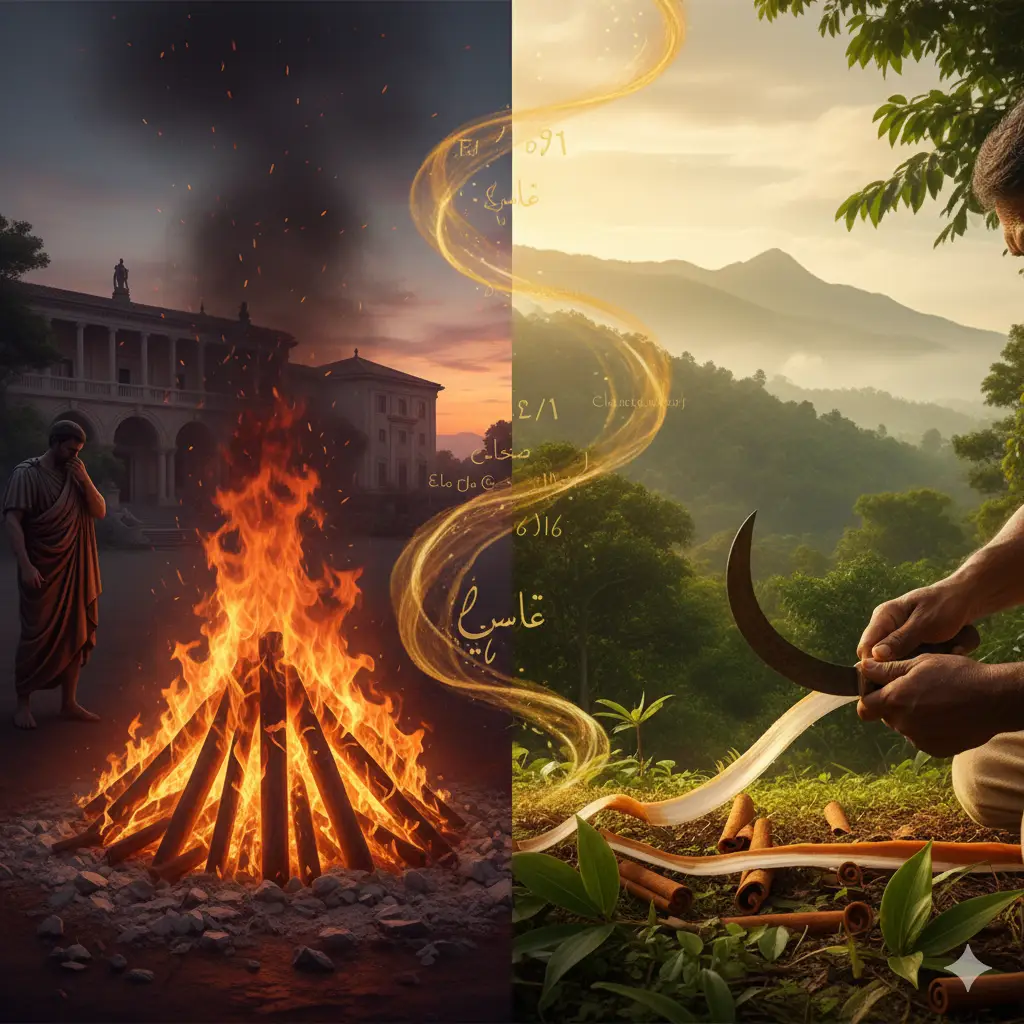
In the Roman Empire, the funeral of a ruling elite was not just an event of mourning but a geopolitical statement. Rome went into such details to guard the pompous formality in the event of a cremation of a Caesar. As legend says they burned the most expensive merchandise on Earth for that. It wasn’t gold, nor was it diamonds. It was a spice, an Eastern mystery traded by Arab merchants who guarded its origin with the ferocity of a state secret. Historical accounts state the very fact that Emperor Nero burned an extravagant amount, reportedly a year’s supply, of this precious spice at the funeral of his wife, Poppaea Sabina, in 65 AD
When the Romans questioned the exorbitant price, the Arabs sold them a carefully crafted myth: they claimed the spice was dropped from the sky by golden birds into inaccessible canyons. By framing it as a “divine” commodity, they ensured no common man could ever taste it, artificially limiting access, creating rarity, and augmenting the price. Isn’t rarity, after all, the mother of luxury?
The Romans, ever the strategists, eventually saw through the smoke. They tracked the trade routes to the Port of Alexandria and followed the monsoon winds until they reached a mystical island then known as Taprobane, or Tambapanni, the land of the copper-red earth. Legend says sailors could smell the island’s aroma miles before they saw its shores. This was the European discovery of Cinnamomum verum (also known as Cinnamomum zeylanicum), the one and only “True Cinnamon” in the world. (It should be noted that while this narrative is rooted in historical accounts, it serves as a popular cultural legend rather than a strictly archaeological timeline).
The Great Deception: Cassia vs. Ceylon
Let us clear the air with the “Steel” of science. What 90% of the world currently consumes as “cinnamon” is an impostor. It is Cassia (Cinnamomum cassia). While it bears an uncanny resemblance and is used globally in mass production, the Cassia tree is a different beast altogether. It is larger, tougher, and chemically distinct, containing high levels of coumarin (which can be toxic in large doses).
True Cinnamon grows only in the soil of Sri Lanka; everything else is a mere mimicry. Arguing that Ceylon Cinnamon and Chinese Cassia are the same is as hollow as claiming a Lion and a Leopard are identical because they belong to the same family. You could quite easily treat your domestic cat as a lion in the same spirit, but the reality remains: True Cinnamon is found only on the island of Sri Lanka. Period.
Food Security as a Weapon of War
Why did European powers spill so much blood over a bark? Before Fred W. Wolf Jr. invented the domestic electric refrigerator in 1913, food security was a battle against decay. Meat was preserved with salt or honey, both of which distorted the palate. Cinnamon was the miracle; it acted as a natural antimicrobial preservative without ruining the flavor.
During the colonial conquests, the Portuguese and the Dutch fought for the “Lion’s share” of this trade, yet they only ever controlled the coastal belts. The interior kings, based in the mountainous Kingdom of Kandy, could, and did disrupt the supply by instigating dissent among the harvesting communities. It took the British, and the eventual betrayal by local elites in 1815, to finally dismantle the independent kingdom and secure the monopoly. It was a classic moment of “cutting off one’s nose to spite one’s face’’ trading sovereign freedom for a seat at the colonial table.
The 2026 Reality
The story is different today, but the tragedy remains. Despite holding the world’s only supply of “True Cinnamon,” Sri Lanka’s earnings remain a fraction of their potential, stagnating at roughly $210 million while the global spice market reaches for billions. We own the blueprint, but the world is still buying the “Cassia” copy.
Next time you reach for cinnamon, for your tea, your curries, or your cakes, do not just look at the price. Look for the origin. Demand Ceylon Cinnamon. Not as an act of charity, but as an act of respect for a historic journey. Hundreds of years ago, men gave their lives so that this aromatic treasure could reach your palate. Do not settle for the impostor. There is, after all, only one True Cinnamon.
Dhanuka Dickwella is a distinguished Sri Lankan poet, author, and multifaceted professional whose work spans literature, geopolitics, and social activism. Holding a Master’s degree in International Relations, he has established himself as an expert in geopolitics and geoeconomics, fields that inform his analytical and creative endeavours.
His professional portfolio includes significant editorial and journalistic roles: he serves as the Executive Editor of The Asian Reviews magazine, a platform dedicated to bridging the literary worlds of East and West. Additionally, he contributes as a guest writer for the Chicago-based Armenian Mirror-Spectator, focusing on geopolitical issues in the Caucasus region, and as a columnist and guest speaker for Force, an Indian magazine addressing security and defense matters. Dickwella’s career in public service is equally notable. Dhanuka Dickwella is the Chief Coordinator for Canada for the Panorama International Literature Festival 2026. He has been actively involved in Sri Lankan politics, having served as a grassroots politician, political campaign director, and council member of a local government body in a rural Sri Lankan town. Prior to his political engagements, he founded and led a foundation dedicated to empowering youth and supporting underprivileged communities, reflecting his commitment to social equity. Currently, he advises youth groups on political activism and broader political trends, leveraging his extensive experience to foster the next generation of civic leaders. Beyond his analytical and political pursuits, Dickwella is a celebrated poet and blogger whose literary work explores the complexities of human emotion and experience. His debut poetry collection, Voices of Lust, Love and Other Things, showcases his ability to weave personal narrative with universal themes. An ardent climate and social activist, he champions sustainable development and social justice, driven by a vision of a better world for future generations. A proud Sri Lankan patriot, Dickwella is also a devoted father to his daughter, whose influence is a cornerstone of his personal and creative life. Dhanuka Dickwella’s diverse achievements reflect a rare synthesis of intellectual rigor, artistic expression, and civic dedication, positioning him as a prominent voice in both Sri Lankan and global contexts.
Leave a Reply