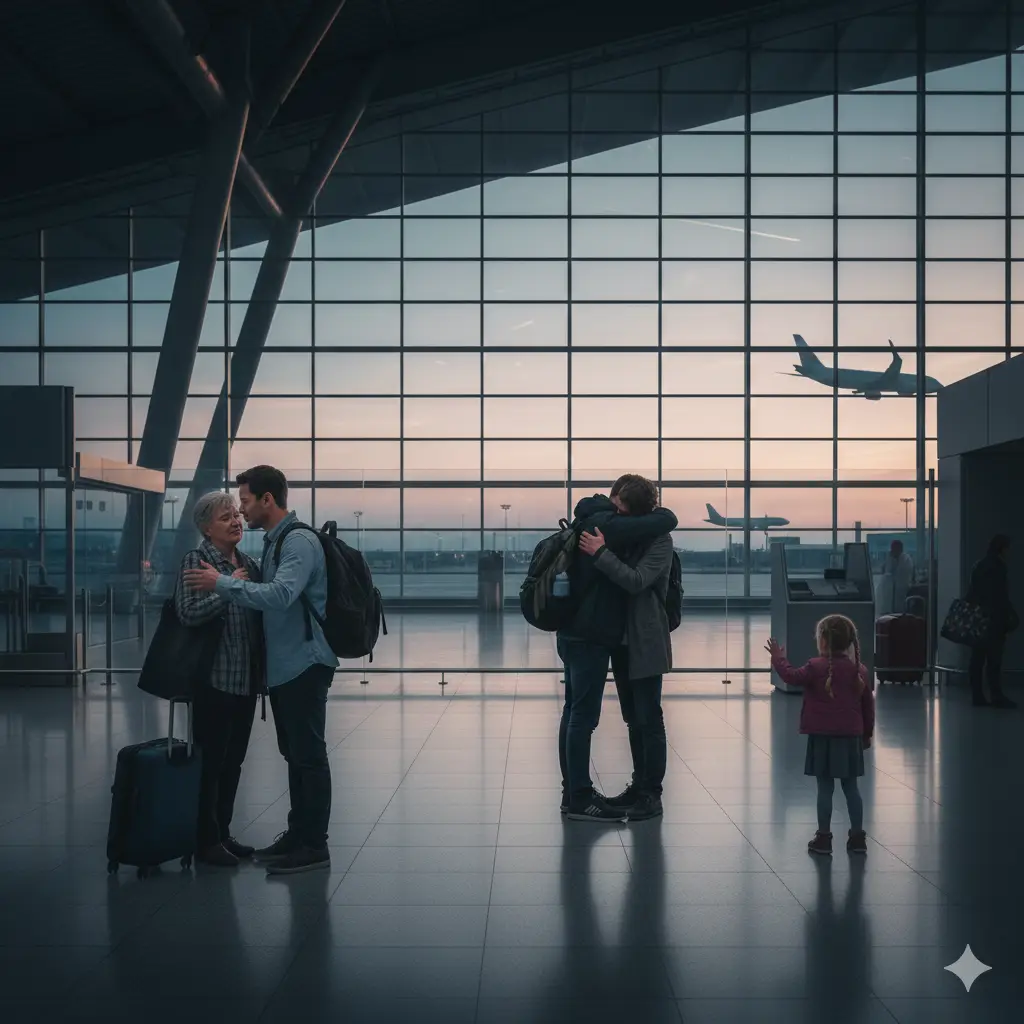
Airports are mysterious places in their own right. We are trained to see them as gateways to adventure, hubs of commerce, or the starting line of a vacation. That notion is not entirely inaccurate but rather incomplete. The perspective would differ depending on the lounge you are in.
Aren’t all departures in life sad and painful ? Now imagine a whole lounge of them !
If you sit on one of those uncomfortable metal benches long enough and really watch, you realize they were built for something else entirely. They are theaters of cruelty.
An airport is a place meant for more than just goodbyes and welcomes. It is a machine designed to process human emotion with industrial efficiency. It is a sterile purgatory that can break someone’s heart or, on rare occasions, make someone feel beyond amazing. But mostly, they are built to stop people from continuing their emotional sagas.
There is a specific line on the floor, usually just before the security gates, that acts like a guillotine. It cuts the narrative. No matter how much you love someone, no matter how desperate the situation, the architecture demands you stop. You cannot hold hands past the scanner. You cannot hug past the passport control. You can not kiss beyond the designated point. The system, environment demands you stop. The building itself forces you to let go with no exception.
Look around the departure terminal. You will see the archetypes of loss.
There is the old mother, adjusting the collar of her son’s shirt one last time. She smiles, but her eyes are terrified. She knows she is about to go back to a lonely house where the silence will be louder than any noise. She knows she might not see him for a year, two years, maybe more. In her mind, she is already counting the days. Only a mother would know the depth of such a pain.
There is the daughter, clinging to her father’s leg or waving frantically at a glass wall. Tonight, she will have to sleep in an empty bed, the safety of her world fractured by a flight number. No amount of gifts, friends, movies would dry her river of tears, fill her emptiness.
There is the wife, watching her husband wheel a suitcase away. She isn’t just missing a person; she is missing the warmth, the safety, and the smell of him in the house. She is already bracing herself for the cold side of the mattress. A space that will remind her every night and morning that she is alone.
And then there is the lover, the one whose heart is being broken in real-time. For lovers, the airport is a torture chamber. You watch the person who holds your soul walk away, and you have to just stand there. You have to endure the indignity of watching them take off their belt and shoes for a security guard while your world collapses.
Regardless of who you are, you have only one choice: say the final goodbye and leave your loved one alone.
This is where the comparison strikes me. The only difference between a cemetery and an airport is that at the airport, we still have our loved ones alive even after leaving them.
In a cemetery, the grief is absolute. It is final. The stone is cold, and the conversation is one-sided. But in an airport, the grief is suspended. It is a “living grief.” You drive home in the same silence as you would from a funeral, but your person is up in the air, eating bad food and watching a movie. They are gone, but they exist.
Does that make it better? Or does it make it worse?
In a cemetery, you eventually find closure. In an airport, you only find waiting, an agony that prevails. You enter a state of suspended animation, living your life in time zones that aren’t yours, waiting for a digital notification to tell you they landed, waiting for the date on the calendar to circle back around.
Unless otherwise, they were pretty much sad places. Is it though?
Maybe there is a twisted beauty in it. If airports are cemeteries for the living, they are also the only places on earth where hope is purely physical. That crushing pain in your chest as you watch the plane taxi away? That is the proof of life. That is the price of having something worth missing. We voluntarily walk into these glass-and-steel heartbreakers because the connection we have is stronger than the pain of separation.
So yes, airports are sad. They are tragic. But unlike the cemetery, the airport makes you a promise: “Not yet.”
The story is paused, not ended. And for that small mercy, we endure the goodbye.

Dhanuka Dickwella is a distinguished Sri Lankan poet, author, and multifaceted professional whose work spans literature, geopolitics, and social activism. Holding a Master’s degree in International Relations, he has established himself as an expert in geopolitics and geoeconomics, fields that inform his analytical and creative endeavours.
His professional portfolio includes significant editorial and journalistic roles: he serves as the Executive Editor of The Asian Reviews magazine, a platform dedicated to bridging the literary worlds of East and West. Additionally, he contributes as a guest writer for the Chicago-based Armenian Mirror-Spectator, focusing on geopolitical issues in the Caucasus region, and as a columnist and guest speaker for Force, an Indian magazine addressing security and defense matters. Dickwella’s career in public service is equally notable. Dhanuka Dickwella is the Chief Coordinator for Canada for the Panorama International Literature Festival 2026. He has been actively involved in Sri Lankan politics, having served as a grassroots politician, political campaign director, and council member of a local government body in a rural Sri Lankan town. Prior to his political engagements, he founded and led a foundation dedicated to empowering youth and supporting underprivileged communities, reflecting his commitment to social equity. Currently, he advises youth groups on political activism and broader political trends, leveraging his extensive experience to foster the next generation of civic leaders. Beyond his analytical and political pursuits, Dickwella is a celebrated poet and blogger whose literary work explores the complexities of human emotion and experience. His debut poetry collection, Voices of Lust, Love and Other Things, showcases his ability to weave personal narrative with universal themes. An ardent climate and social activist, he champions sustainable development and social justice, driven by a vision of a better world for future generations. A proud Sri Lankan patriot, Dickwella is also a devoted father to his daughter, whose influence is a cornerstone of his personal and creative life. Dhanuka Dickwella’s diverse achievements reflect a rare synthesis of intellectual rigor, artistic expression, and civic dedication, positioning him as a prominent voice in both Sri Lankan and global contexts.
Leave a Reply