“Europe is both the cradle of human rights and the birthplace of totalitarianism.” — Tony Judt, historian
This timeless expression resonates with Europe, both past and present. From warring tribes to hawkish kings, global empires, Nazi regimes, and the Warsaw Pact, this history has now converged into a new era of elite consensus. This time around, they wear the badges of democracy, lead such forums and say they fight for the rights of the humans. Yet at its core, the same apathy toward its stated mission persists: the pursuit of absolute control over their societies.
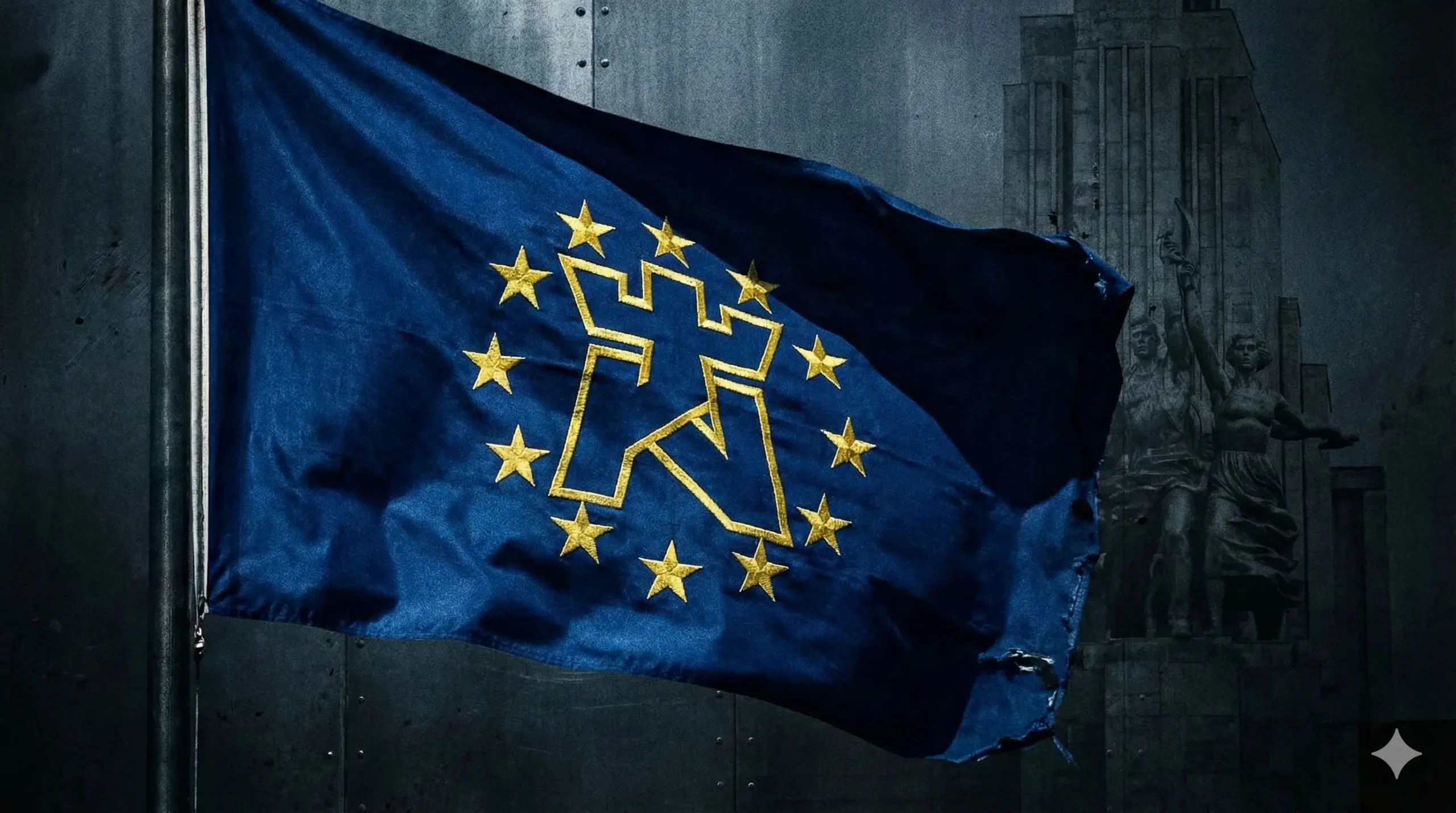
In the twilight of the liberal international order, a disturbing transformation is underway across the continent. What was once hailed as the world’s most advanced experiment in post-national democracy, built on principles of peace, human rights, and economic interdependence by some of the greatest thinkers, economists, leaders and citizenry, now increasingly resembles a rigid ideological bloc. It enforces conformity through sanctions, political smears, and pervasive silence on inconvenient truths. To many in the Global South, the European Union no longer looks like a union of democracies. It resembles a thing from the past that was known as the Warsaw Pact. Only this time, this “new Warsaw Pact” is on steroids: centralized, punitive, and morally selective.
The evidence is overwhelming and accelerating.
Democratic Theater in the Heart of Europe
Democracy is a funny thing at times since the commitment to democratic pluralism could often be bent when political unity is threatened. Perhaps simply twisted by shapeshifting the narrative.
Consider France. President Emmanuel Macron gets routed in the 2024 European Union elections by Marine Le Pen’s National Rally with 32% votes, almost a double of what Macron’s Renaissance party got. He called for snap elections only to be routed yet again, this time by the socialist NFP, while giving Le Pen her best results ever. While the president’s coalition lost its majority, the resulting political fragmentation gave a mandate to no single party.
What does he do? Rather than allowing the strongest opposition bloc to attempt forming a government, he appointed his own prime minister who did not survive a no confidence motion months later. Democracy spoke, yet what did the president do next? Appoint another one instead of respecting the obvious. The second appointee has a fait accompli and predictably gets defeated by another no confidence motion. The third resigns days after the appointment. But the president is determined to hold on to power at all costs and recalls the man to continue the job. This move was widely interpreted not as democratic responsiveness, but as a desperate power play, resulting in political paralysis and public disillusionment. If you still believe this political charade is called democracy, I have a bridge to sell you.
This is not an anomaly. In Romania, opposition voices are routinely branded “pro-Russian” and marginalized from public discourse. The winner of the first round of a recent election was blocked from running in the second round. The entire election was recalled with different, manageable players. In South Asian political cultures, this was the reality in the 80s. The method of silencing the opposition, handpicking manageable pawns. Even for us, this is now a thing in the past and a practice our societies would never allow.
Journalists face persistent pressure for questioning NATO policy or official orthodoxy. In the Baltics, Russian-speaking minorities face intensified scrutiny over geopolitical allegiances they never chose, including challenges to long-held citizenship rights. In Poland and Croatia, judicial independence has been challenged and sometimes sacrificed at the altar of “European values”, ironically, by the very institutions claiming to defend them.
When dissent is systematically penalized under the guise of national security, democracy risks becoming a choreographed performance, not a core principle.
From Economic Union to Geopolitical Council
The European Commission appears to have abandoned its original mission: to foster prosperity and integration among member states. Instead, it now functions as a de facto foreign policy and war council, dictating energy policy, arms transfers, and diplomatic alignments across the continent while its economies suffer and deteriorate. Once flourished Europe is now stuck in an economic stagnation marred by corruption and policies that wont serve the national economies of its members.
The Commission has effectively usurped NATO’s role, not through military command, but through economic coercion. Neutral or skeptical states like Slovakia and Hungary are politically marginalized or threatened with sanctions for refusing to toe the line on Russia policy. National parliaments find themselves increasingly overruled on matters of war and trade. The Commission no longer appears to serve citizens; it serves a single geopolitical doctrine, one that brooks no significant deviation.
This is not governance. It is ideological centralization, a top-down control mechanism eerily reminiscent of the Soviet era’s political demands for unity across its sphere of influence.
Moral Bankruptcy on the Global Stage
Nowhere is Europe’s duplicity more glaring than in its selective outrage, a policy of strategic hypocrisy.
While the EU demands accountability and sanctions for Russia’s invasion of Ukraine, a legitimate concern, it maintains a stark double standard elsewhere. The EU has continued to treat Israeli Prime Minister Benjamin Netanyahu as a partner, despite the International Criminal Court prosecutor’s formal request for an arrest warrant over alleged war crimes in Gaza. With tens of thousands of Palestinians killed, the EU has struggled to support firm UN ceasefire resolutions, continued arms exports, and refused unified recognition of Palestinian statehood.
Furthermore, the EU embraces Azerbaijan’s Ilham Aliyev, who in 2023 oversaw the military offensive that resulted in the effective ethnic cleansing of Nagorno-Karabakh, expelling over 100,000 ethnic Armenians. Weeks after this expulsion, the EU signed a major €10 billion gas deal with Baku. For the EU, some dictators are not so bad, after all. In this calculus morality is calibrated not by the severity of human suffering, but by energy interests and alliance politics and sheer hypocrisy.
Fueling Global Authoritarianism
Europe’s democratic decay doesn’t remain contained; it radiates outward, lending legitimacy to authoritarians worldwide.
Autocrats from Ankara to Madagaskar now point to Europe and say: “See? Even the established democracies use emergency powers, silence critics, and manipulate institutional levers. Why should we be held to a higher standard?” When core members dissolve parliament after an electoral loss, or journalists face political persecution, the line between liberal democracy and soft authoritarianism dangerously blurs.
Worse, Europe’s far-right parties, like the AfD, RN, and Fidesz, thrive on the perceived moral bankruptcy of the EU establishment. Their message, “Brussels dictates, we resist”, resonates because it contains a kernel of truth about overreach. As these parties gain power, they export their playbook: civilizational nationalism, anti-immigrant rhetoric, and disdain for genuine multilateralism.
The tragic irony is that by sacrificing internal democratic integrity for geopolitical unity, the EU isn’t containing authoritarianism, it’s accelerating its global normalization. A true tragedy of our times.
The Warsaw Pact with Better Wine
The original Warsaw Pact was a Soviet-led military alliance that enforced ideological conformity through tanks and treaties, controlled by the Kremlin bosses. Today’s EU enforces conformity through SWIFT bans, visa denials, market access, moral shaming or simply outright banning. The tools have changed, but the fundamental logic remains: you are either with us, or against us. Worst of all, they despise constructive criticism, a fundamental pillar in a Democratic society.
To the Global South, this is not democracy. It is hegemony dressed in humanitarian language.
If the EU wishes to reclaim its moral authority and position as a global standard-bearer, that it once was, it must do three things:
Restore Democratic Pluralism at Home: Ending the political criminalization of dissent and respecting the outcomes of democratic choice, even when inconvenient.
Apply Principles Universally: Condemning crimes in Gaza and Nagorno-Karabakh with the same unwavering vigor as those committed in Ukraine.
Return to its Economic Mission: Prioritizing the welfare and integration of its citizens, rather than serving solely as a vehicle for waging geopolitical proxy wars.
But most importantly, it has to remember that the world does not revolve around them and does not want to be forced into ideological camps. The free states are sovereign enough to forge their own paths and choices.
Until these steps are taken, the world will increasingly see it for what it has become: not a beacon of liberal democracy, but the Warsaw Pact on steroids, with better wine, worse hypocrisy, and no soul.
EU,

Dhanuka Dickwella is a distinguished Sri Lankan poet, author, and multifaceted professional whose work spans literature, geopolitics, and social activism. Holding a Master’s degree in International Relations, he has established himself as an expert in geopolitics and geoeconomics, fields that inform his analytical and creative endeavours.
His professional portfolio includes significant editorial and journalistic roles: he serves as the Executive Editor of The Asian Reviews magazine, a platform dedicated to bridging the literary worlds of East and West. Additionally, he contributes as a guest writer for the Chicago-based Armenian Mirror-Spectator, focusing on geopolitical issues in the Caucasus region, and as a columnist and guest speaker for Force, an Indian magazine addressing security and defense matters. Dickwella’s career in public service is equally notable. Dhanuka Dickwella is the Chief Coordinator for Canada for the Panorama International Literature Festival 2026. He has been actively involved in Sri Lankan politics, having served as a grassroots politician, political campaign director, and council member of a local government body in a rural Sri Lankan town. Prior to his political engagements, he founded and led a foundation dedicated to empowering youth and supporting underprivileged communities, reflecting his commitment to social equity. Currently, he advises youth groups on political activism and broader political trends, leveraging his extensive experience to foster the next generation of civic leaders. Beyond his analytical and political pursuits, Dickwella is a celebrated poet and blogger whose literary work explores the complexities of human emotion and experience. His debut poetry collection, Voices of Lust, Love and Other Things, showcases his ability to weave personal narrative with universal themes. An ardent climate and social activist, he champions sustainable development and social justice, driven by a vision of a better world for future generations. A proud Sri Lankan patriot, Dickwella is also a devoted father to his daughter, whose influence is a cornerstone of his personal and creative life. Dhanuka Dickwella’s diverse achievements reflect a rare synthesis of intellectual rigor, artistic expression, and civic dedication, positioning him as a prominent voice in both Sri Lankan and global contexts.
Leave a Reply