Ideas are so powerful that any authority, in any era, must guard against them. Historically, this caution has been directed at movements that ignite rebellion, change the tide of global trends, or challenge established power. This is why intelligence agencies monitor not just foreign states, but domestic thought.
In Sri Lanka, this mechanism of control has historically relied on inflaming racial and religious insecurity. This form of scaremongering kept the country profoundly polarized for decades, pitting neighbors, vendors, and colleagues against one another, resulting in tragic bloodshed.
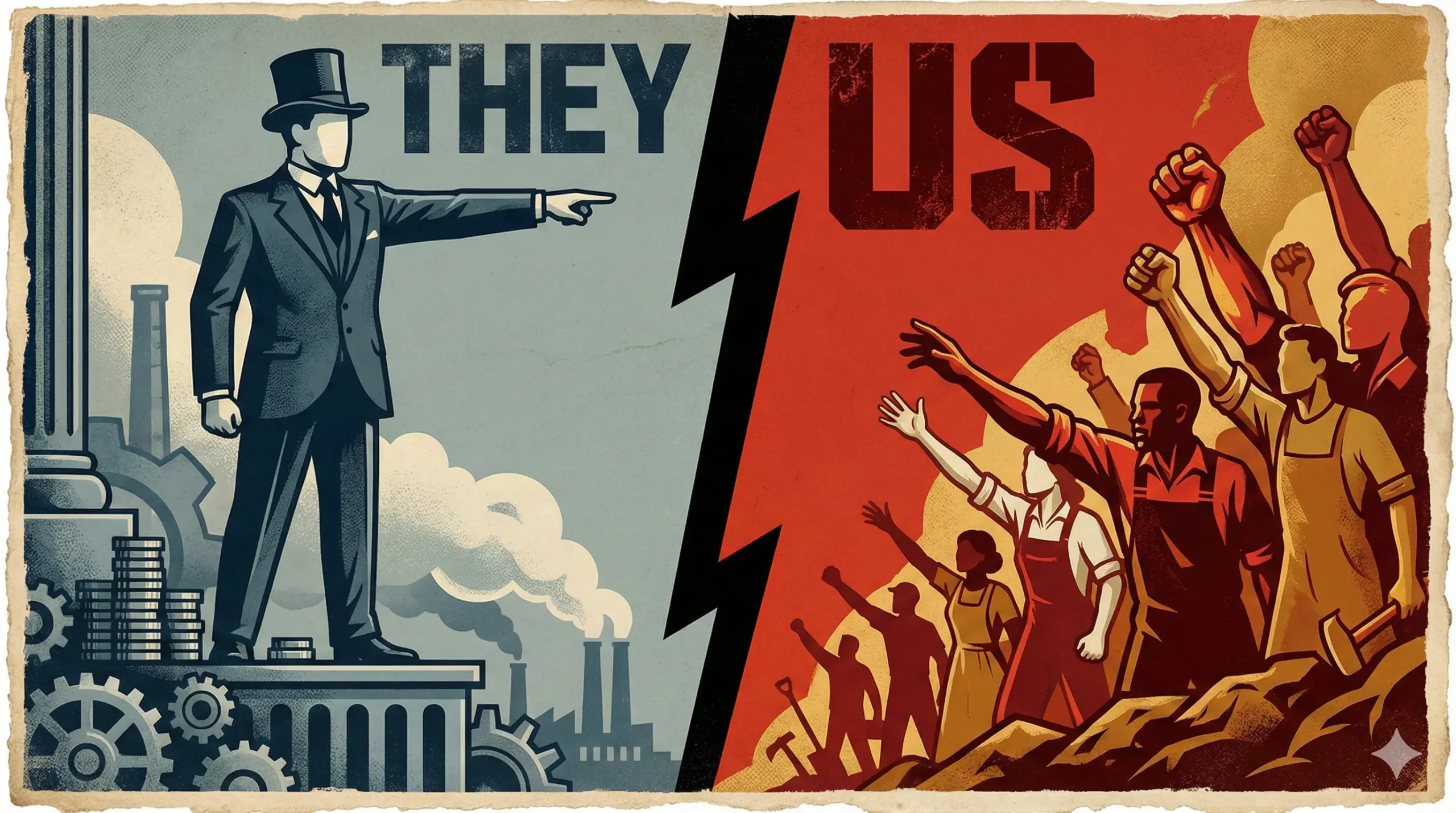
The current administration, led by the JVP who themselves went through a near total political and physical annihilation, came to power on a mandate to stop this destructive polarization and unify Sri Lankans. But there is always a gulf between policy, practice and political realism. As common to any political movement, the JVP must still consolidate its power, defuse opposition, and sustain its hold on the electorate. Having failed to achieve that core goal in the past through violence and destruction, the JVP strategists have now engaged a new, potent tool to manipulate the nation, divide the populace, and maintain a vice-like grip on voters. This method is called ‘’ The theory of Them and Us. or ‘’ Us against Them.’’
The JVP’s New Stratagem – The Class War Paradigm
The arrest of a major political figure, such as former President Ranil Wickremesinghe, is not an unusual phenomenon globally, although new to Sri Lanka. Power politics is a dirty game, and leaders, even one as powerful as a former US President, have faced prosecution and legal scrutiny .President Trump’ s mugshot would serve as the epitome of the culmination of political witch hunts in this century.
The Sri Lankan political opposition, in the case of Wickremesinghe’s arrest, predictably united in solidarity, declaring the action anti-democratic. It is the counter-argument to this solidarity that reveals the JVP’s core strategy.
The JVP’s response is simple and strategically devastating: “Look, they are in solidarity, they are together, they are one camp, they are the same. They are the elites, the rich, and the higher class.”
Underneath every JVP analysis, writing, and public interpretation, there is a clear, promoted class division:
“They”: The rich, the mighty, the elite class. They represent the old guard, corruption, and the forces working against the nation’s interest.
“Us”: The poor, the weak, the working class, and the masses. They represent virtue, purity, and the “Just Cause of Action.”
This is not a political policy; it is a mandatory social narrative.
The Forced Guilt Trip: Sovereign Thought Under Pressure
In this new class war paradigm, the JVP effectively weaponizes economic anxiety and resentment:
Virtue by Association: Everything the “Us” (the government and its supporters) does is for the greater good of society, making it the most noble act. An exemplary citizen must be part of the “Us” and wage the class war to keep “Them” at bay.
Guilt by Criticism: Everything the “They” do is a conspiratorial act against the public interest. Crucially, the JVP strategy forces critics onto a mandatory guilt trip: If you criticize the government or its policies on democratic grounds, you are automatically branded as a partisan of the elite class.
There are tens of daily examples.’’A minister misuses an official vehicle? Ignore it, the abuse was worse under the previous “Them.”
Or perhaps, ‘’The President uses a helicopter for personal reasons? Look away; it is the noble act of humanity by one of “Us.”
The simple argument is that no citizen is allowed to criticize the government of the working class. Critics are deemed “anti-revolutionists,” “political slaves,” or “henchmen who benefited from the old regimes.” How about critical thinkers, constructive critics, independent opinion bearers ? Well there is no such thing.
The Geopolitical Danger: Replacing One Polarization with Another
The JVP strategists have successfully convinced a large segment of the public that their democratic mandate was, in fact, a socialist revolution,not merely an election victory. The goal is now to “nip the buds of anti-revolutionists.”
The danger of this shift, viewed through a geopolitical lens, is twofold.
Internal Instability and Suppression of Dissent: By dividing the country along a new class parallel, the JVP creates an environment where legitimate democratic criticism is suppressed and labeled as sabotage. This undermines the institutions of democracy and chills the free flow of ideas necessary for national accountability and reform.
Risk to External Relations: The “Them vs. Us” framework extends to the global sphere. A government that views internal critics as “anti-revolutionists” may apply similar filters to international partners. This mindset risks alienating global financial partners, the IMF, or other necessary geopolitical allies, potentially pushing Sri Lanka back towards the destabilizing, polarized politics that crippled its economy in the first place.
The JVP has successfully managed to replace a deadly religious/racial divide with a potentially equally destructive class divide and forced guilt trip. It won’t be long before the government accuses even neutral observers and critics of being part of the wealthy, anti-revolutionist citizenry. For a nation desperate for stability, this new polarization is a sovereign trap.
Dhanuka Dickwella is a distinguished Sri Lankan poet, author, and multifaceted professional whose work spans literature, geopolitics, and social activism. Holding a Master’s degree in International Relations, he has established himself as an expert in geopolitics and geoeconomics, fields that inform his analytical and creative endeavours.
His professional portfolio includes significant editorial and journalistic roles: he serves as the Executive Editor of The Asian Reviews magazine, a platform dedicated to bridging the literary worlds of East and West. Additionally, he contributes as a guest writer for the Chicago-based Armenian Mirror-Spectator, focusing on geopolitical issues in the Caucasus region, and as a columnist and guest speaker for Force, an Indian magazine addressing security and defense matters. Dickwella’s career in public service is equally notable. Dhanuka Dickwella is the Chief Coordinator for Canada for the Panorama International Literature Festival 2026. He has been actively involved in Sri Lankan politics, having served as a grassroots politician, political campaign director, and council member of a local government body in a rural Sri Lankan town. Prior to his political engagements, he founded and led a foundation dedicated to empowering youth and supporting underprivileged communities, reflecting his commitment to social equity. Currently, he advises youth groups on political activism and broader political trends, leveraging his extensive experience to foster the next generation of civic leaders. Beyond his analytical and political pursuits, Dickwella is a celebrated poet and blogger whose literary work explores the complexities of human emotion and experience. His debut poetry collection, Voices of Lust, Love and Other Things, showcases his ability to weave personal narrative with universal themes. An ardent climate and social activist, he champions sustainable development and social justice, driven by a vision of a better world for future generations. A proud Sri Lankan patriot, Dickwella is also a devoted father to his daughter, whose influence is a cornerstone of his personal and creative life. Dhanuka Dickwella’s diverse achievements reflect a rare synthesis of intellectual rigor, artistic expression, and civic dedication, positioning him as a prominent voice in both Sri Lankan and global contexts.
Leave a Reply