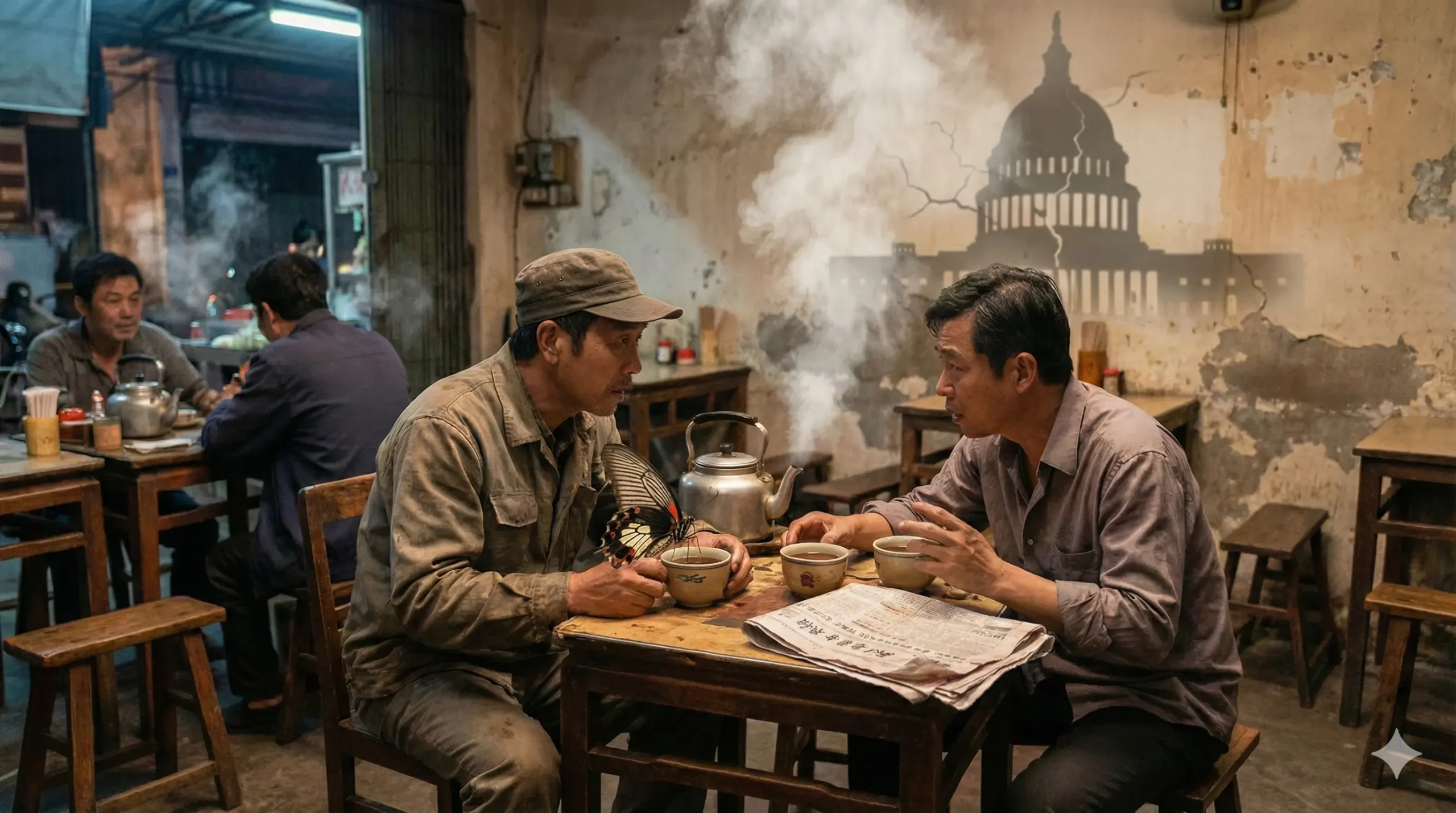
The Kremlin, the White House, and Buckingham Palace embody the raw essence of civilization: the concept of Power. Each of these locations is a nerve center capable of transforming not only its occupants and the host country, but the entire humanity, in the space of a few moments. The same magnitude is held by the Vatican, Mecca, and the Sacred Tooth Relic Temple of Kandy, but within an entirely different context. Wall Street, the London Stock Exchange, and Beijing Financial Street carry, for their part, the power of commerce. While each locality seems to exert an influence far greater than its physical size, it begs the question: what true power can a simple Tea Shop hold?
A precise description of the type of tea shop in question is necessary as a prelude. In most parts of Asia, one cannot miss these small boutiques where people sit, read a newspaper, or play a game while enjoying a cup of tea. In the not-so-distant past, every village possessed such an entity where groceries could also be bought. The most important thing is that these tea shops functioned as the primary gathering point where people came together to talk, converse, relay messages, spread news, exchange ideas, seek clarifications, give opinions, engage in heated debate, and argue on everything from religion to politics. There was a spicier side: the patrons’ penchant for a little gossip about village dwellers and local celebrities. Although the establishment’s primary purpose was to generate profits, it gave rise to a well-sustained ecosystem that encompassed everyone in a village. It was the postman’s break point, the policeman’s information center, and the local hub of trade. Undoubtedly, a tea shop owner enjoyed immense civil power, yet without the ecosystem of its visitors, that influence was nothing.
Although times have changed and the tea shops have evolved, moving away from their ultra-traditional look to become more chic, clean, and perhaps more sophisticated in their palate, none of their fundamental functionalities have changed. Tea shops are still a central communication hub where people continue to gather to carry out the functions of civilization.
While one must agree wholeheartedly that no tea shop in the world could push the red button to fire a nuclear missile, announce a strict religious decree, impose a new tax, or declare wars, the tea shops truly hold the power to change the outcome of any such decisions. The crowd that gathers is the one who pays taxes, who will take a gun and go to war, who will donate to religious establishments, pray to the gods the leaders endorse, and who, perhaps, will start a revolution. They are not merely foot soldiers who carry out the orders, but an integral and powerful part of that power chain. What they discuss, the opinions they create, and the arguments they sustain reach not just the households but an entire grassroots network.
High on a cup of tea, two ordinary people can give birth to a revolutionary idea that can easily ignite a nation’s patriotism, nationalism, or even racism. Perhaps a shared grievance could become a rallying call for a nationwide strike, a concentrated boycott movement, or an armed rebellion. A scribbled note in a tea shop could be the lyrics of a song that touches the hearts and minds of a generation. Conversations made, arguments sustained, debates deliberated, lyrics sung, notes scribbled, anger expressed, and emotions shared among the ordinary folk in a tea shop thus carry a weight that outweighs brewing a storm inside a teacup; instead, they create a butterfly effect capable of causing a violent storm. In Chaos Theory, it is said that a butterfly flapping its wings in one place could, in theory, alter atmospheric conditions that eventually lead to a tornado or hurricane in another location. That is the magnitude of power a Tea Shop and its patrons hold. One must look at this place with the same spirit, merit, mindset, and relevance. The pillars of power—whether resting on national parliaments, presidential palaces, political party headquarters, militant garrisons, tech hubs, or wealthy financial centers—all ultimately rely on what takes place inside a tea shop.
Times have changed, and the inhabitants of tea shops have evolved. Whether they carry a hoe on their shoulder or a sleek laptop, or whether they drink a sugary plain tea or a fancy Matcha iced latte, it will be the tea shops and their visitors who will decide how the world functions and the direction of civilization. Any ruler, political or otherwise, who fails to comprehend the intricate, unparalleled, unique nature of this power center is prone to end up being just another footnote in history.

Dhanuka Dickwella is a distinguished Sri Lankan poet, author, and multifaceted professional whose work spans literature, geopolitics, and social activism. Holding a Master’s degree in International Relations, he has established himself as an expert in geopolitics and geoeconomics, fields that inform his analytical and creative endeavours.
His professional portfolio includes significant editorial and journalistic roles: he serves as the Executive Editor of The Asian Reviews magazine, a platform dedicated to bridging the literary worlds of East and West. Additionally, he contributes as a guest writer for the Chicago-based Armenian Mirror-Spectator, focusing on geopolitical issues in the Caucasus region, and as a columnist and guest speaker for Force, an Indian magazine addressing security and defense matters. Dickwella’s career in public service is equally notable. Dhanuka Dickwella is the Chief Coordinator for Canada for the Panorama International Literature Festival 2026. He has been actively involved in Sri Lankan politics, having served as a grassroots politician, political campaign director, and council member of a local government body in a rural Sri Lankan town. Prior to his political engagements, he founded and led a foundation dedicated to empowering youth and supporting underprivileged communities, reflecting his commitment to social equity. Currently, he advises youth groups on political activism and broader political trends, leveraging his extensive experience to foster the next generation of civic leaders. Beyond his analytical and political pursuits, Dickwella is a celebrated poet and blogger whose literary work explores the complexities of human emotion and experience. His debut poetry collection, Voices of Lust, Love and Other Things, showcases his ability to weave personal narrative with universal themes. An ardent climate and social activist, he champions sustainable development and social justice, driven by a vision of a better world for future generations. A proud Sri Lankan patriot, Dickwella is also a devoted father to his daughter, whose influence is a cornerstone of his personal and creative life. Dhanuka Dickwella’s diverse achievements reflect a rare synthesis of intellectual rigor, artistic expression, and civic dedication, positioning him as a prominent voice in both Sri Lankan and global contexts.
Leave a Reply